Last Updated: October 22, 2026
Last Updated: October 22, 2026





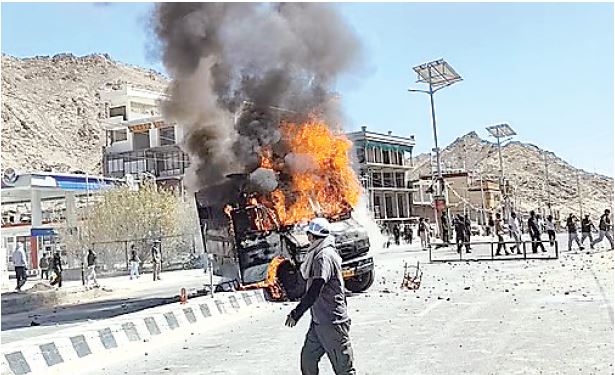
A region long known for its fragile environment and delicate politics witnessed one of its worst episodes of unrest this week. A shutdown call in Leh turned violent, leaving four people dead and more than 70 injured after demonstrators clashed with police. The violence has thrown fresh light on the grievances of Ladakhis, the growing role of activism in the region, and the Centre’s handling of dissent.
The protests were led by climate activist Sonam Wangchuk, who has in recent months emerged as a powerful voice demanding constitutional and environmental safeguards for the region. Wangchuk had been on a 15-day hunger strike, urging protection of Ladakh’s fragile ecology, land, and culture. His fast ended after the clashes, but not before he became a central figure in the escalating standoff.
Demonstrators poured onto the streets after calls for a shutdown to press for greater autonomy and safeguards under the Sixth Schedule. According to eyewitnesses, the protests began peacefully but spiralled into violence when security forces moved in to disperse the crowds. Police used batons and tear gas, while protesters hurled stones and blocked roads. By the end of the day, four lives were lost and dozens were hospitalised with injuries.
The Centre moved quickly to lay blame on Wangchuk, accusing him of provoking the violence. Officials alleged that his speeches had inflamed passions, pointing in particular to remarks referencing “Gen Z protests in Nepal” as an inspiration for Ladakhi youth. Wangchuk rejected the allegations but was arrested soon after, a move that has further polarised opinion in the region.
For the people of Ladakh, the protests are the latest expression of frustration since the region was carved out as a Union Territory in 2019. Many had initially welcomed the separation from Jammu and Kashmir, seeing it as a chance for direct governance from Delhi. But disillusionment has grown over the years. Local leaders and activists say the promised safeguards for land, jobs, and cultural preservation have not materialised. The demand for inclusion under the Sixth Schedule of the Constitution, which would grant protections to tribal communities and restrict outside ownership of land, has become a rallying cry.
The economic strain of climate change and rapid development projects has only added urgency. Ladakh’s environment is highly sensitive to changes in water use, tourism, and infrastructure growth. Activists argue that unchecked projects, combined with lack of local say in governance, are eroding both ecology and community rights. Wangchuk has positioned himself as the voice of this cause, calling for a model of development that is sustainable and participatory.
The government, however, views the unrest through a different lens. Officials stress that Ladakh’s strategic location bordering China and Pakistan makes stability a national priority. They argue that granting excessive autonomy could create governance challenges and expose the region to external manipulation. The arrest of Wangchuk and the strong police response underline this security-first approach.
Yet the violence has made clear that discontent cannot be brushed aside. The deaths of four protesters have intensified anger, with calls for accountability and compensation for victims’ families. Opposition parties have seized on the events to question the Centre’s policies in Ladakh, accusing it of silencing dissent rather than addressing legitimate concerns.
Observers note that the crisis has arrived at a sensitive time, with India under global scrutiny for its handling of environmental issues and minority rights. Ladakh, often showcased for its pristine landscapes and Buddhist heritage, now risks being remembered for unrest and state-citizen confrontation.
The coming weeks will be critical. The administration faces the task of restoring order while opening channels for dialogue with Ladakhi leaders. For Wangchuk, now in custody, the violence may either cement his role as a symbol of resistance or expose him to charges of fuelling instability. For ordinary Ladakhis, the urgent question remains unresolved: whether their voices will finally be heard in shaping the future of their land.
As calm slowly returns to the streets of Leh, the silence is uneasy. Beneath it lies the reality that the demands for autonomy, ecological protection, and recognition are far from settled. The protests may have been quelled for now, but Ladakh’s unrest has only just begun to find its place in the national conversation.
Good Evening Viewers! Get the latest updates from India and around the world with The Savera Times Evening...

Bharatiya Janata Party (BJP) National General Secretary Smriti Zubin Irani launched a scathing attack on Congress MP and...
New Delhi: Cockroach Janata Party (CJP) leaders Saurav Das and Ashutosh Ranka will be released from judicial custody...
According to police, three suspicious young men are seen in CCTV footage. Efforts are underway to identify them....
A video has surfaced of an alleged attempted assault on Jan Suraj Party's Bihar president Manoj Bharti. The...
Two accused have been convicted and sentenced to 10 years of rigorous imprisonment in a 2017 drug trafficking...
Aries: The day will be auspicious...