Last Updated: September 23, 2026
Last Updated: September 23, 2026





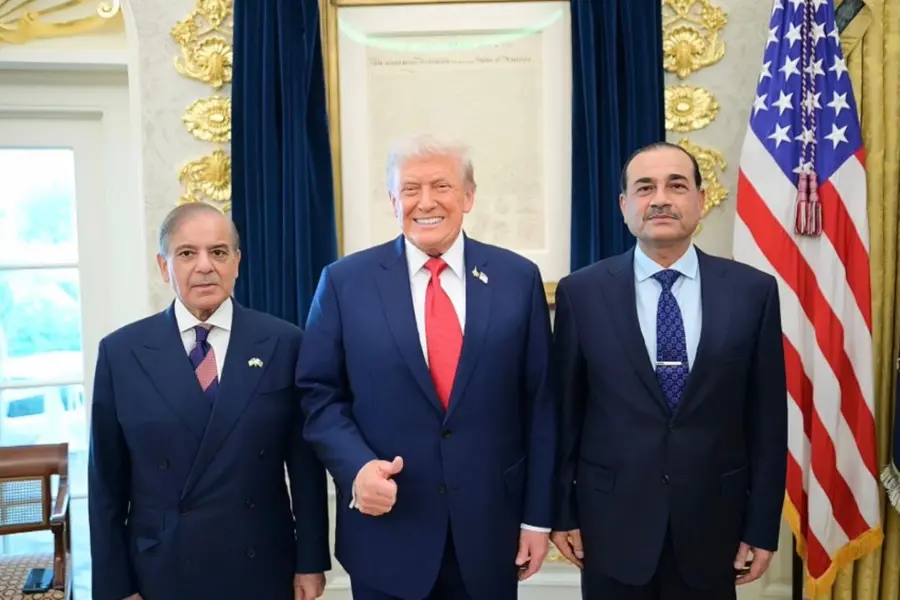
Un i t e d S t a t e s President Donald Trump hosted Pakistan’s Prime Minister Shehbaz Sharif and Field Marshal Asim Munir at the White House on Thursday, September 25, in what is being seen as a clear sign of warming relations between Washington and Islamabad.
The rare high-level meeting, which was also attended by US Vice President JD Vance and Secretary of State Marco Rubio, lasted around 90 minutes and focused on a wide range of issues, from counterterrorism to investment opportunities. The talks came on the sidelines of the United Nations General Assembly session in New York, where Sharif was present along with other world leaders. For Pakistan, the meeting provided an important platform to engage directly with the US administration on strategic, security, and economic priorities.
For Washington, it was another opportunity to expand its diplomatic footprint in South Asia at a time of growing regional challenges. Inside the Oval Office P r e s i d e n t T r u m p welcomed Sharif and Munir to the Oval Office, speaking warmly about the visiting delegation. “We have a great leader coming, the Prime Minister of Pakistan, and the Field Marshal of Pakistan. Field Marshal is a very great guy and so is the Prime Minister, both,” Trump told reporters at the White House shortly before the meeting began.
The delegation arrived at the White House at 4:52 pm, with discussions beginning about half an hour later than planned due to Trump’s prior commitments. By 6:18 pm, the Pakistani officials had departed, after what sources in Islamabad later described as “frank, wide-ranging, and forward-looking talks.” The meeting itself was closed to the media, with official photographs later shared by the Pakistani government showing Trump smiling and giving a thumbs-up alongside Sharif.
Broad Agenda on Security and Economy According to senior Pakistan government sources quoted by News18, the meeting revolved around three key areas: security cooperation, economic engagement, and strategic partnership. Sharif extended an invitation to American companies to invest in Pakistan’s agriculture, technology, mining, and energy sectors, underlining the country’s potential in rare earth minerals and emerging industries such as crypto mining.
Sharif’s office later issued a statement saying the Prime Minister expressed confidence that under Trump’s leadership, the Pakistan-US partnership would be strengthened further “to the mutual benefit of both countries.” Washington is reported to have expressed strong interest in Pakistan’s natural resources, particularly rare earth minerals and opportunities in oil exploration.
Both sides also agreed in principle to deepen collaboration in counterterrorism efforts, with plans to explore a comprehensive agreement covering security, strategic cooperation, and investments. Gaza and Regional Security The war in Gaza also featured prominently in the discussions. Sharif praised Trump’s “efforts to bring about an immediate end to the conflict,” reflecting Pakistan’s position in line with other Muslim-majority nations calling for peace in West Asia.
Beyond Gaza, the two sides addressed wider regional issues. Pakistani officials raised concerns about terrorism threats emanating from Afghanistan, unrest in Balochistan, and the ongoing situation in Kashmir. According to sources, Trump assured Sharif and Munir of “full US support and cooperation” in countering terrorism threats linked to Afghan soil.
The talks also touched on China’s growing influence in the region, the Taliban’s role in Afghanistan, and the strategic importance of the Bagram Airbase. Trump was said to have welcomed the recently signed PakistanSaudi defence agreement and commended Islamabad’s role in supporting stability across South Asia and West Asia. A Strategic Reset The White House meeting is seen as a significant marker in US-Pakistan relations, which have undergone a visible shift since Trump’s return to office in January.
This was the first time Sharif and Trump had met at the White House since the Pakistani leader assumed office last year, and it followed a series of quiet but steady engagements in recent months. Field Marshal Asim Munir has visited the US twice since June, including for a private lunch at the White House hosted by Trump, signaling the deepening of military-to-military ties. Officials familiar with the matter described Thursday’s talks as “highly significant and security-focused.” Ties have also been boosted by Pakistan’s decision to nominate Trump for the 2026 Nobel Peace Prize, citing his “decisive diplomatic intervention” during the recent India-Pakistan crisis.
Trump himself has publicly claimed credit for brokering a ceasefire after a four-day conflict between the two South Asian rivals in May, although New Delhi has rejected those assertions. Contrasting Relations with India The growing closeness between Washington and Islamabad comes at a time when relations between the US and India are strained. The Trump administration recently imposed 50 per cent tariffs on Indian exports, including a 25 per cent penalty linked to New Delhi’s purchase of Russian oil. For analysts, the shift in focus toward Pakistan marks an important recalibration in US South Asia policy, with Trump seeking to leverage Islamabad’s strategic position and resources.
Looking Ahead As ties strengthen, reports indicate that Pakistan and the US are working toward signing a comprehensive agreement covering security, counterterrorism, and economic cooperation. This deal could potentially include investments in rare earth mineral extraction, oil exploration, and technology sectors. Sharif also extended an invitation to Trump to visit Pakistan, an offer that could materialize in the coming year.
Meanwhile, US Secretary of State Marco Rubio is expected to travel to Pakistan in October or November to continue discussions. For both sides, the meeting underscored a renewed willingness to move past earlier frictions and rebuild a partnership grounded in security, economic opportunity, and regional stability. As one senior source in Islamabad put it, “The relationship between Washington and Islamabad is gradually warming up.”
Canadian Prime Minister Mark Carney has said that Prime Minister Narendra Modi is expected to visit Canada in...
The Nepal Tourism Board (NTB) has issued a safety advisory for tourists following a warning from authorities that...
Iran's Foreign Ministry spokesperson Esmail Baghaei on Tuesday (local time) responded to US President Donald Trump's remarks during...
The recent attacks by Houthis on Saudi Arabia show that the Mecca Joint Defence Agreement is largely symbolic...
Residents in Pakistanoccupied Kashmir (PoK) have been facing an internet shutdown for more than 100 days with the...
Himanshu Nitnaware Australian seabirds are being found with record amounts of plastic in their stomachs, with plastic ingestion...
Aries: The day will be auspicious...