Last Updated: October 14, 2026
Last Updated: October 14, 2026





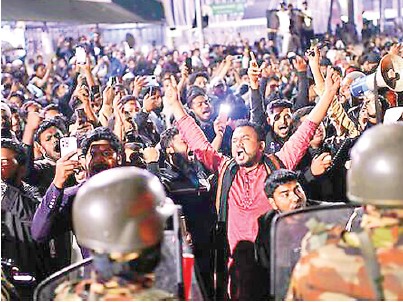
Sharif Osman Hadi’s death didn’t just hit Bangladesh politically — it sparked a nationwide explosion of anger, anti-India sentiment, and violent protests that have shaken the country’s already fragile political landscape. Hadi wasn’t just any activist. He was a high-profile figure in Bangladesh’s 2024 mass uprising — a youth leader with a fierce anti-India stance who helped shape the narrative of resistance against what many of his followers saw as foreign interference in Bangladesh’s politics.
Hadi was shot in Dhaka on December 12 while campaigning ahead of the country’s general election, scheduled for February 12, 2026. Around midday in the Bijoynagar area, two masked gunmen on a motorcycle opened fire on him as he rode in a battery-powered rickshaw, hitting him in the head. He was rushed to Dhaka Medical College Hospital, then moved to a private facility as his condition worsened, and finally flown to Singapore for advanced medical care. Despite doctors’ efforts, he died on December 18.
For many, Hadi represented more than a politician. He was a key spokesperson for Inqilab Mancha — a political platform born out of the student-led July 2024 uprising that helped force former Prime Minister Sheikh Hasina from power. That movement was built on demands for deep political reforms, including a constitutional ban on the Awami League’s dominance, and was deeply suspicious of India’s influence in Bangladesh. Hadi himself had openly promoted fiercely anti-India ideas and even circulated a controversial map of a so-called “Greater Bangladesh” that included parts of Indian territory, which only amplified his polarizing reputation.
His death hit a tinderbox society. Within hours of the announcement that he had died in Singapore, crowds poured into the streets of Dhaka and other cities, from Shahbagh to Rajshahi, Chattogram and beyond. What had started as protests demanding justice and accountability quickly morphed into something much bigger: chants against India, attacks on political symbols, and violent confrontations with authorities. Roads were blocked, highways were disrupted, and panic spread as demonstrators expressed deep resentment toward both the interim government and India.
One of the most dramatic flashpoints was in Dhaka’s Karwanbazar area, where mobs vandalized and set fire to the offices of Prothom Alo and The Daily Star — Bangladesh’s two largest newspapers — accusing them of being biased and aligned with Indian interests. Journalists were trapped inside the burning buildings for hours before firefighters rescued them.
Protesters also stormed political offices and historical sites tied to Bangladesh’s political history. In Rajshahi, an Awami League office was torched; in Dhaka, the residence of Sheikh Mujibur Rahman — the country’s founding father — faced vandalism. The unrest wasn’t confined to just anti-government actions; it clearly took a turn toward anti-India rhetoric as demonstrators marched toward Indian diplomatic premises, shouted anti-India slogans, and hurled stones at the Indian Assistant High Commission in Chattogram.
Part of what intensifies the situation is the broader context of Bangladesh’s domestic politics.
Sheikh Hasina, long a close ally of India, was ousted in 2024 and later sentenced to death in absentia for alleged crimes during the uprising. She has been in exile in India, and many protesters blame India for sheltering her and for what they see as too much influence over Bangladesh’s internal affairs. Anti-India sentiment, which Hadi embodied, had already been simmering and was now boiling over with his death.
The interim government, led by Nobel laureate Muhammad Yunus, has tried to walk a tightrope. Yunus declared a national day of mourning, calling Hadi a martyr and promising to hunt down his killers and bring them to justice. He urged citizens to remain calm and restraint, even as violence spread in cities across the country. The government launched a nationwide manhunt and released images of suspects linked to the shooting, but that has done little to quell public fury.
Students and youth groups have played a central role in sustaining the protests. At universities across Bangladesh, demonstrations have turned into organized marches and sit-ins demanding accountability not just for Hadi’s death but also for broader systemic issues they see as unresolved — from alleged police inaction to the exclusion of fair political competition in upcoming elections.
Regional implications are already surfacing. India temporarily closed some of its visa application centres in Bangladesh for security reasons amid anti-India protests and diplomatic tensions, and it has summoned Bangladesh’s envoy in response to security concerns in Dhaka. The situation adds another layer of strain to bilateral ties between two neighbors whose political and economic relationships have been crucial.
In essence, Sharif Osman Hadi’s death became a catalyst because he was not just a political figure but a symbol. For his supporters, he was the voice of resistance against perceived external domination and internal political exclusion. His assassination — and the perception that the state failed to protect him — tapped into deep currents of frustration, nationalism, and distrust. Now, Bangladesh is in a moment of intense upheaval, with protests that go beyond a single death and reflect broader anxieties about the country’s future direction.
A major train accident occurred on Tuesday in the Multan district of Pakistan's Punjab province. At least four...
Canadian Foreign Minister Anita Anand will arrive in New Delhi on an official visit on Tuesday. During her...
International human rights organization Amnesty International has expressed serious concern over the alleged arbitrary arrests of prominent leaders...
US President Donald Trump says Vladimir Putin may be more willing than Volodymyr Zelenskyy to reach a peace...

A magnitude 6.1 earthquake struck Panama early Tuesday at a depth of 10 kilometres. The tremor followed a...

US President Donald Trump has indicated the possibility of meeting North Korean leader Kim Jong Un during his...
Aries: The day will be auspicious...