Last Updated: October 21, 2026
Last Updated: October 21, 2026





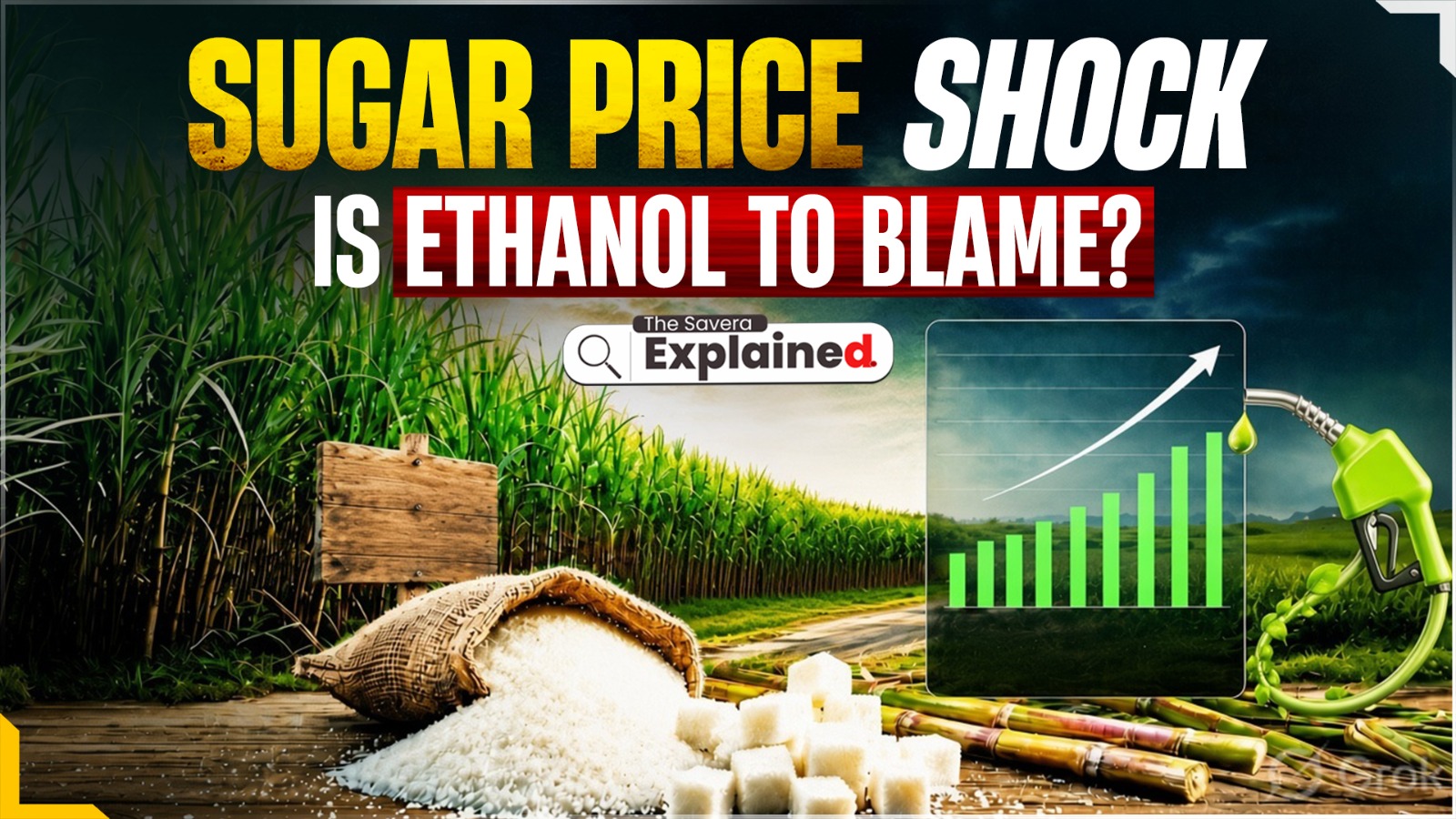
Sugar has suddenly become a hot topic in Indian households. Prices have jumped sharply just ahead of the festive season, while the country is also pushing ahead with its ethanol-blending target to reduce crude oil imports. So, is the same sugarcane being used for fuel responsible for making sugar more expensive? The answer is not that simple.
Why Are Sugar Prices Rising?
Government data shows that sugar prices increased from Rs 48.18 per kg on July 20 to Rs 55.70 per kg on August 20, 2026. The government says the rise is mainly due to lower-than-expected sugar production, weather-related crop damage, stronger festive demand, tighter global supplies and speculation or hoarding.
India’s sugar production for the 2025-26 season is now estimated at around 306 lakh tonnes, compared with the initial estimate of 343 lakh tonnes. That is a shortfall of nearly 11 per cent. Excess rainfall, waterlogging and diseases such as red rot and top borer damaged sugarcane crops in important producing areas.
At the same time, global sugar prices have also increased. International prices rose from about 474 dollars per tonne on June 30 to 552 dollars on August 20, an increase of more than 16 per cent.
Where Does Ethanol Come Into the Picture?
India’s ethanol programme was expanded to solve a different problem — surplus sugar.
In years when sugar production is high, excess stocks can block the money of sugar mills and delay payments to farmers. Diverting some sugarcane and sugar by-products towards ethanol gives mills another source of revenue and supports the sugarcane economy.
The government says the share of sugar diverted towards ethanol has actually fallen — from around 12 per cent in 2022-23 to about 9 per cent in 2025-26. Nearly three-fourths of India’s ethanol now comes from grain feedstocks, particularly maize.
India has also rapidly expanded its ethanol capacity. The country’s ethanol production capacity reached around 1,953 crore litres by October 2025, compared with 215 crore litres in 2013.
So, Is Ethanol Responsible?
This is where experts disagree.
Agricultural economist Ramesh Chand argues that ethanol cannot be blamed as the principal reason for the current sugar price surge. According to him, the immediate problem is the unexpected fall in sugar production caused by weather and crop diseases. He also points to stronger festival demand and firm international prices.
But economist Ashok Gulati takes a different view. He agrees that lower production and depleted stocks are at the heart of the problem, but says diversion of some sugarcane towards ethanol has added to the pressure. Gulati has also criticised the government for acting too late and suggested that sugar imports or temporarily reducing cane diversion to ethanol could have eased the pressure earlier.
The Bigger Food Versus Fuel Debate
The real issue is not simply sugar versus ethanol. It is about maintaining a balance between food security and energy security.
India is pursuing E20 petrol to reduce its dependence on imported crude oil. But when sugar production falls sharply, diverting cane towards fuel can become more sensitive because the same crop has to serve two purposes.
The government maintains that adequate sugar stocks are available and has taken measures against hoarding. It has also allowed sugar imports to strengthen domestic availability. Stock limits have been imposed on dealers, while the government expects the new crushing season to improve supplies.
So, is ethanol the villain?
Not entirely. The current sugar price surge appears to be the result of several factors — lower production, crop damage, festive demand, global prices and speculative activity. Ethanol diversion may have added some pressure, as Gulati argues, but government data does not support calling it the sole or principal cause.
The bigger lesson is clear: as India moves towards E20 and greater energy security, it must ensure that fuel policy does not come at the cost of affordable food.
Ladakh is seeing two changes at once: a new district has been announced, and the Centre has proposed...

What if a decision taken in Washington could influence India’s oil bills, export earnings and trade relations with...

What happens when the world’s richest business leaders clash over one of the world’s biggest internet markets? A...

Pakistan is heading into its wheat-growing season with a serious water problem. The country is facing a projected...
Imagine a foreign national standing among Indian citizens at a political protest, raising questions about the government or...

For thousands of Indian tech workers in the United States, a job offer is only the beginning of...

Aries: The day will be auspicious...