Last Updated: October 15, 2026
Last Updated: October 15, 2026





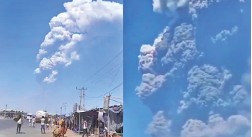
Ethiopia’s Hayli Gubbi volcano has erupted for the first time in nearly 12,000 years, sending a towering ash plume up to 14 km into the atmosphere and disrupting aviation across several countries. The eruption, which began on November 23, pushed volcanic ash thousands of kilometres across the Red Sea and the Gulf before it drifted over Pakistan and brushed past northern India. Delhi did not witness visible grey dust, but the ash at cruising altitudes triggered significant flight disruptions and raised questions about possible effects on air quality.
Satellite imagery showed the ash cloud spreading over North India before moving eastward towards China. Forecasts indicated that the plume would clear Indian airspace by early evening. The presence of high-altitude ash, however, forced aviation authorities to take swift action. More than 40 flights were affected, with cancellations and rerouting across major airlines.
Air India cancelled 11 flights as a precaution to avoid exposure to the volcanic plume. Akasa Air suspended all flights to Jeddah, Kuwait and Abu Dhabi for November 24 and 25. IndiGo cancelled six flights. In total, 28 flights were diverted to avoid the contaminated airspace. International carriers were also impacted, including KLM, which paused select operations. Mumbai’s Chhatrapati Shivaji Maharaj International Airport issued an advisory stating that volcanic activity in Ethiopia was affecting parts of West Asian airspace and could disrupt certain international routes.
Despite the aviation impact, experts maintain that India’s surface air quality is unlikely to deteriorate due to this eruption. The ash remains at high altitudes and is expected to continue dispersing without settling over the plains. The plume’s trajectory and rapid atmospheric dilution have reduced the chance of ground-level pollution spikes, even in regions already struggling with smog such as Delhi.
The renewed global attention has sparked interest in the Hayli Gubbi volcano itself, a remote shield volcano located in Ethiopia’s Afar Region. It forms the southernmost part of the Erta Ale volcanic range, an area known for its geological activity. Hayli Gubbi sits at an elevation of about 493 metres, but unlike its more active neighbours, it has shown no confirmed eruptions throughout the Holocene period. That long period of dormancy ended with the recent explosive event.
The November 23 eruption sent ash to heights of 13–15 km, or nearly 45,000 ft, well within the cruising levels used by commercial aircraft. This altitude makes volcanic ash particularly dangerous because ash particles can damage engines, coat sensors, and reduce visibility. The eruption also released large quantities of sulfur dioxide, which can travel far across continents. Although sulfur dioxide at high altitudes can influence regional weather patterns and contribute to atmospheric haze, experts say its short-term presence is unlikely to worsen India’s surface pollution.
Detection of the eruption relied almost entirely on satellite monitoring due to the remoteness of the Afar Region. The terrain is harsh, sparsely populated and difficult to access, making ground-based observations limited. Advanced satellite systems from international space agencies tracked the ash plume as it moved across Ethiopia, Eritrea and the Red Sea before spreading into West Asia and South Asia.
The plume’s rapid movement highlights how volcanic activity in one part of the world can affect air travel thousands of kilometres away. India’s aviation sector, which connects major hubs across the Middle East, was caught directly in the plume’s path. Airlines responded with caution, avoiding long-term engine damage that volcanic ash can cause. The decision to cancel or reroute flights is standard safety protocol when volcanic material is detected, even if the particles remain high above the surface. For now, the event remains a stark reminder of how interconnected global airspace has become, and how natural events in remote regions can disrupt flight patterns, travel plans and logistical networks far beyond their immediate vicinity.
Texas Attorney General Ken Paxton has filed a lawsuit against baby food manufacturer Gerber and its parent company,...

US President Donald Trump has urged voters to treat the November 3 midterm elections as though he were...

19-year-old man has been arrested for allegedly plotting a mass shooting at a Hindu temple in Illinois, US....

US President Donald Trump has called for people leaking sensitive military information to be shot, claiming reports about...

US President Donald Trump has renewed his suggestion that Canada become the 51st American state, criticising Canadian tariffs...

US President Donald Trump has predicted that the war with Iran will end very soon and energy prices...

Aries: The day will be auspicious...