Last Updated: October 26, 2026
Last Updated: October 26, 2026





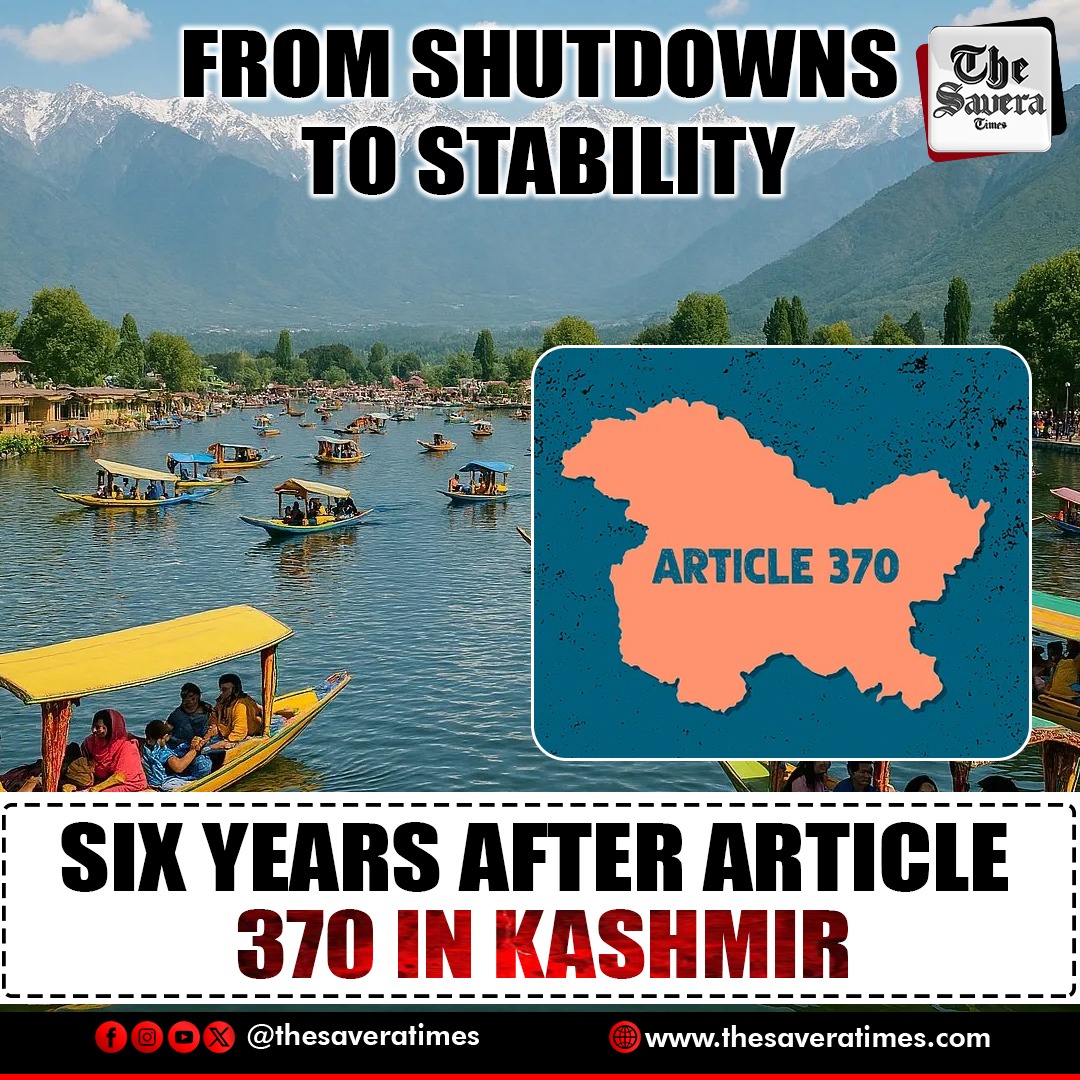
Srinagar: As Jammu and Kashmir marks six years since the abrogation of Article 370, the Union Territory has witnessed notable developments in security, infrastructure, tourism, and investment. The Modi government views these changes as evidence of normalization and long-term integration of the region with the rest of India.
On August 5, 2019, the Centre revoked Article 370, ending the special constitutional status of Jammu and Kashmir and bifurcating the state into two Union Territories—Jammu & Kashmir and Ladakh.
Security Situation Shows Improvement
According to officials, there has been a significant drop in incidents of terrorism, stone-pelting, and shutdowns since 2019. The Home Ministry attributes this to its “zero-tolerance” policy on terror. Peaceful observance of Muharram and Janmashtami processions in Srinagar, for the first time in decades, has been cited as a sign of growing stability.
“Organized stone-pelting has completely stopped. People now feel safer going about their daily lives,” said Subhan, a shopkeeper in the city. Security forces maintain high alert across sensitive areas, but the number of civilian casualties and clashes has declined substantially, according to official data.
Massive Investment and Industrial Growth
Economic indicators show a surge in private sector interest. Over ₹12,000 crore has been invested in the last ten years alone—nearly matching the ₹14,000 crore received in the previous seven decades. An additional ₹1.10 lakh crore in MoUs is currently being implemented under the UT’s industrial policy.
“The government’s policy has brought Kashmir on the radar of national and international investors,” said a Jammu and Kashmir administration official. Real estate, logistics, and food processing sectors are showing growth, aided by improved infrastructure and simplified land acquisition rules.
Tourism Sector Records Unprecedented Growth
In 2023, the region received a record 2.11 crore tourists, the highest ever in a single year. Industry insiders say the growth in tourism has revived local businesses and created jobs in hospitality and transport.
“Where militancy once deterred visitors, we now have tourists flocking to Dal Lake and Gulmarg,” said a hotelier. The hosting of the G20 Tourism Working Group meeting in Srinagar earlier this year further boosted global confidence in the region’s security and infrastructure.
Infrastructure Development Accelerates
Out of the ₹80,000 crore package sanctioned by Prime Minister Narendra Modi in 2015, ₹51,000 crore has already been spent on 63 major projects, including roadways, tunnels, health infrastructure, and power generation.
Projects like the Z-Morh and Zojila tunnels are reducing travel time between Kashmir and the rest of the country. Expansion of railway networks is underway to link Kashmir more directly with India’s core rail grid.
Home Minister Amit Shah has called the changes “irreversible,” stating that the government remains committed to ensuring lasting peace, economic growth, and equal opportunity in the Union Territory. While critics continue to demand restoration of statehood and political representation, the government insists its developmental and security-oriented approach is delivering results on the ground.
Imagine opening WhatsApp on your phone, but the SIM card linked to your account is not inside the...

Delhi’s air pollution is once again raising health concerns, with the Air Quality Index (AQI) entering the ‘poor’...

Ladakh is seeing two changes at once: a new district has been announced, and the Centre has proposed...
What if a decision taken in Washington could influence India’s oil bills, export earnings and trade relations with...

What happens when the world’s richest business leaders clash over one of the world’s biggest internet markets? A...

Pakistan is heading into its wheat-growing season with a serious water problem. The country is facing a projected...
Aries: The day will be auspicious...