Last Updated: October 22, 2026
Last Updated: October 22, 2026





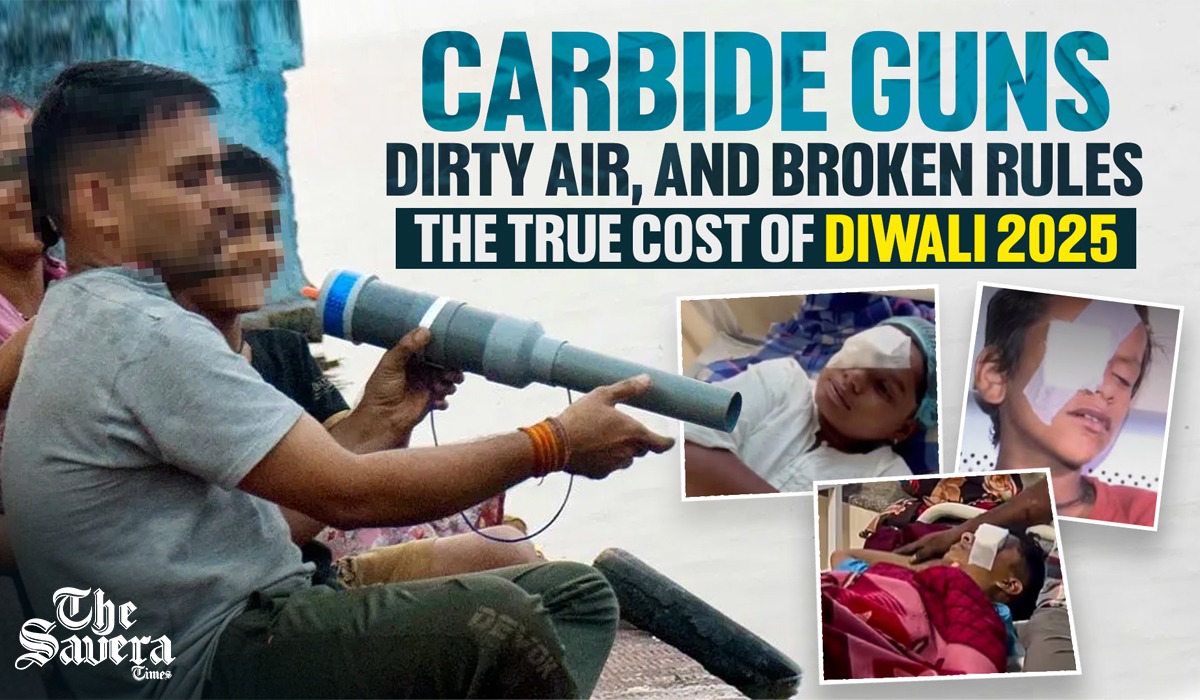
This Diwali, the festival of lights turned into a festival of danger. Across India, what was meant to bring joy ended up causing pain, panic, and pollution.
From toxic air to illegal firecrackers — and now, a shocking new trend — carbide guns, the celebrations exposed a worrying side of our festival spirit.
Carbide Guns: A New Threat
In Bhopal, Madhya Pradesh, carbide guns became a disturbing hit among children. These crude devices are made by mixing calcium carbide — an industrial chemical — with water in a plastic bottle. The mixture produces acetylene gas, which explodes with fire and noise.
Sold openly for ₹50 to ₹100 and advertised as “Diwali fun guns,” these are anything but toys. The blasts can shoot flames and debris strong enough to damage eyes or burn skin.
Hospitals in Bhopal treated over 150 children with serious eye injuries — corneal burns, cuts, and even blindness. Many needed surgery, and some may never regain full vision.
It wasn’t just Bhopal. Similar cases appeared in Lucknow, Kanpur, Mumbai, Pune, Jaipur, and Chennai. Across many hospitals, four out of ten firecracker injuries this year were linked to carbide guns. Experts say the rise is due to easy availability of calcium carbide, meant for welding or fruit ripening, but sold freely by vendors and online.
Delhi’s Air Crisis
While children battled injuries, Delhi faced another silent threat — toxic air. Pollution spikes every Diwali, but this year, official monitors showed a “very poor” Air Quality Index (AQI) of 250–300, not alarming enough.
Independent sensors told a harsher story. PM2.5 levels shot above 400, in the “severe” range. Visibility dropped below 100 meters, and residents reported burning eyes, sore throats, and coughing fits. Experts say some government monitors are placed in cleaner areas, and data may be delayed or smoothed to avoid emergency actions.
Hospitals saw a 35% increase in breathing-related cases within two days. For people with asthma, the elderly, and children, the air itself became dangerous.
Green Crackers: Rules Ignored
In 2018, the Supreme Court mandated only green crackers — designed to reduce pollution by 30% and noise under 125 decibels — with bursting hours from 8 to 10 PM. Yet, this Diwali 2025, these rules were widely ignored, even after the Court’s October 15 relaxation allowing green crackers for two days in Delhi-NCR as a “test case.”
Markets in Delhi, Kolkata, and Bengaluru were flooded with illegal and mislabeled firecrackers. Many claimed to be “green” but contained banned chemicals like barium nitrate. Fireworks continued past midnight, and noise in residential areas reached 140 decibels — enough to damage hearing.
Police seized nearly 20,000 kg of banned firecrackers nationwide, including 943 kg in Mumbai and Rs 4.82 crore worth at Nhava Sheva port, but supply far exceeded seizures. Manufacturers admitted only about 15% of crackers sold were truly green, with fakes using cloned QR codes evading checks.
The Human Cost
Across India, over 600 firecracker-related injuries were reported within 24 hours of Diwali night, up from previous years due to lax enforcement. 60% of the victims were children under 15, including 122 in Madhya Pradesh from carbide guns alone, where 14 lost eyesight permanently. Most suffered burns (45%), eye injuries (35%), and hand or face blasts (15%).
At least two dozen required emergency surgeries to save their vision, including corneal transplants for carbide blast victims. Hospitals like AIIMS and Safdarjung in Delhi treated over 300 cases (55 at AIIMS and 129 at Safdarjung), while Sion in Mumbai and Sarojini Devi Eye Hospital in Hyderabad managed dozens more — a tragic repeat of previous years, overwhelming burn and ophthalmology wards.
Modern Habits Make Things Worse
These celebrations are more dangerous than a decade ago. Social media spreads viral videos of risky “cracker towers” or “1000-shot challenges, showing how festive celebrations can turn into fatal.`
E-commerce platforms quietly ship banned fireworks, including smuggled Chinese imports. Online tutorials even show youngsters how to make homemade explosives like carbide guns. In crowded cities, poor wind circulation and high-rise buildings trap smoke, keeping the air toxic for days — with Delhi’s post-Diwali AQI hitting 451 and peaks over 650 in areas like Anand Vihar.
Beyond One Night
The dangers don’t end with Diwali night. Respiratory illnesses rose by 25–30% in the following week, with NCR hospitals reporting a 400% jump in cases like breathlessness and asthma attacks amid AQI levels crossing 400. Families spend thousands on burn treatments and eye surgeries.
Schools and offices see higher absenteeism due to pollution-related sickness. With studies linking air pollution to 1.6 million premature deaths annually, Diwali spikes — exacerbated by low winds and stubble burning — only worsen an ongoing national crisis.
A Call for Safer Celebrations
Diwali doesn’t have to be deadly. Experts suggest:
The festival of lights can still bring joy — without costing lives, lungs, or trust. Until citizens, vendors, and officials choose safety over spectacle, Diwali will continue to shine under a shadow of smoke.
Ladakh is seeing two changes at once: a new district has been announced, and the Centre has proposed...
What if a decision taken in Washington could influence India’s oil bills, export earnings and trade relations with...

What happens when the world’s richest business leaders clash over one of the world’s biggest internet markets? A...

Pakistan is heading into its wheat-growing season with a serious water problem. The country is facing a projected...
Imagine a foreign national standing among Indian citizens at a political protest, raising questions about the government or...
For thousands of Indian tech workers in the United States, a job offer is only the beginning of...

Aries: The day will be auspicious...