Last Updated: October 21, 2026
Last Updated: October 21, 2026





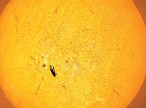
In the vast skies above Arizona, a scene unfolded that seemed plucked straight from the realms of myth and imagination. Astrophotographer Andrew McCarthy, known for his meticulous attention to celestial detail, achieved what many would call a once-in-a-lifetime photograph: a man free-falling across the face of the Sun. The image, titled “The Fall of Icarus,” captures YouTuber and skydiver Gabriel C. Brown seemingly suspended in midair against the glowing solar disc, a visual that leaves viewers questioning whether it could possibly be real.
Yet this is no trick of editing or AI-generated illusion. The photograph is the result of weeks of painstaking planning, precision timing, and technical ingenuity. On November 5, Brown jumped from a small aircraft at around 3,500 feet, while McCarthy positioned his telescopes approximately 8,000 feet away, carefully monitoring the descent through specialized solar telescopes tuned to hydrogen-alpha light. The choice of this wavelength allowed McCarthy to capture not only the silhouette of the skydiver but also the intricate texture and activity on the Sun’s surface—a detail that elevates the image from stunning to extraordinary.
The preparation involved more than just determining the right altitude. McCarthy and Brown meticulously coordinated the timing of the jump, the aircraft’s flight path, and the telescope alignment, all while ensuring strict safety measures. As Brown recalls, the duo had to factor in the aircraft’s power-off glideslope, the optimal angle of the Sun, and the precise communication required to synchronize the leap with McCarthy’s cameras. Weeks of testing and calculation culminated in mere seconds of free-fall that would define the final shot.
“This might be the first photograph of its kind in existence,” McCarthy reflects. He describes it as the “most preposterously fake-looking real photo” he has ever captured—a testament not only to the challenge of the shot but also to the sheer audacity behind it. In a behind-the-scenes video, McCarthy details how he monitored live feeds, instructed Brown over radio, and captured a rapid series of frames to freeze the motion. His exclamation, “I got it, dude!” encapsulates the exhilaration of a moment years in the making.
Timing played a critical role beyond the logistics of the jump. The Sun itself was in a highly active phase of its 11-year cycle, producing fierce solar storms and flares that added dynamic texture to the image. Just days earlier, the strongest solar flare of the year had caused radio blackouts across parts of Africa and Europe. For McCarthy, this solar activity was more than a backdrop—it was a once-in-a-cycle opportunity to showcase the Sun’s power alongside human daring.
The photograph has sparked global fascination, drawing awe from both enthusiasts and casual viewers alike. Social media users have described it as “insanely epic” and “absolutely magnificent,” with many praising McCarthy’s ability to push the boundaries of astrophotography. His work is often noted not merely for its technical brilliance but for its imaginative scope, transforming familiar celestial objects into thrilling, almost narrative moments.
This is not McCarthy’s first viral success. Earlier this year, he captured the International Space Station crossing the Sun, framing the massive solar flare in the background—a combination of timing, precision, and patience that has become his hallmark. With “The Fall of Icarus,” he has again demonstrated that astrophotography can blend science, art, and storytelling, reminding us that even in the age of digital manipulation, careful observation and human creativity can produce images that are both impossible to believe and impossible to forget.
Protests in Jakarta, Yogyakarta and Bandung brought students onto the streets over rising costs, forest fires and civil...

Organisations linked to Neville Roy Singham are under US congressional scrutiny over funding. Their coverage of protests in...

US President Donald Trump says Washington and New Delhi are close to a trade agreement that will differ...

Iran has ruled out transferring its enriched uranium stockpile outside the country, with security official Mohsen Rezaei reiterating...

Donald Trump has urged Volodymyr Zelensky to pursue a peace deal with Russia, warning that Ukraine could face...

Pakistan, battling insurgencies at home and tensions along multiple borders, is too overstretched to offer meaningful military support...
Aries: The day will be auspicious...