Last Updated: October 26, 2026
Last Updated: October 26, 2026





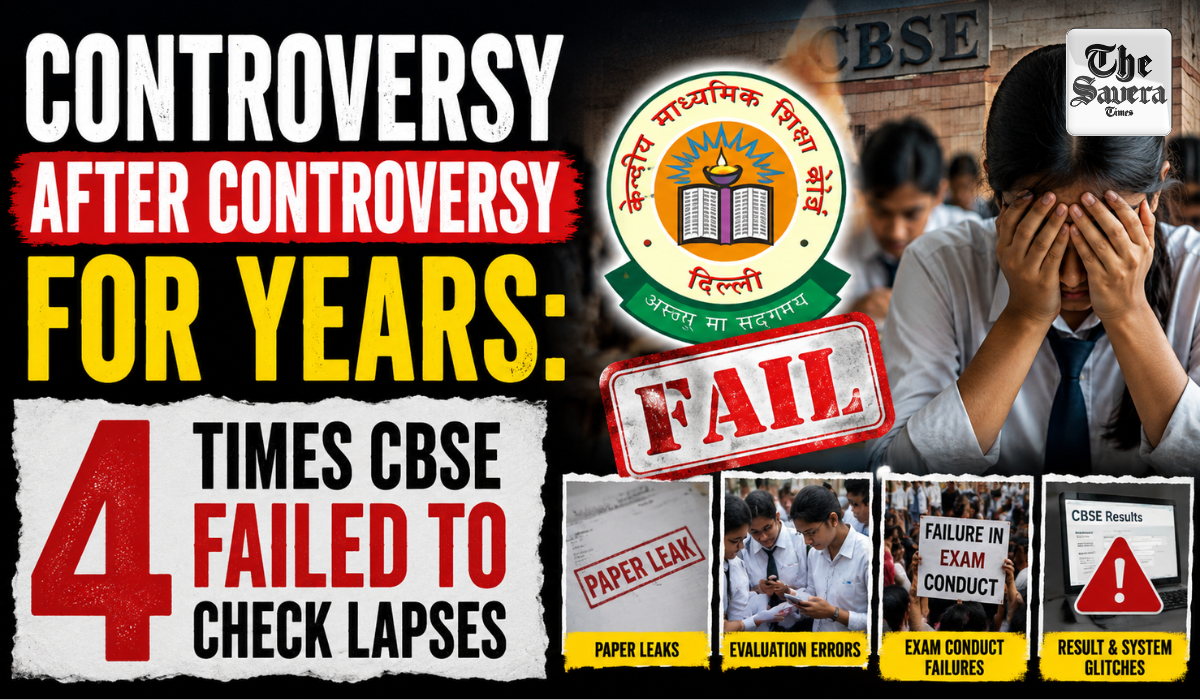
Imagine working hard for months, writing your Class 12 boards, and then seeing marks so low that your future plans collapse.
This year, lakhs of students are asking one question: Why did the CBSE’s new digital marking system rob us of our hard-earned scores? Blurry scans, missing pages, wrong totals, and a crashing portal — this is the latest chapter in CBSE’s long story of repeated failures.
Today, we look at the background, what went wrong now, and four major lapses over the years.
Background: What is CBSE and the New OSM System?
CBSE stands for Central Board of Secondary Education. It conducts Class 10 and 12 board exams for over 20,000 schools across India and abroad. Nearly 2 million students appeared for Class 12 exams this year.
The board introduced the On-Screen Marking (OSM) system for the first time nationwide in 2026. In this system, answer sheets are scanned, uploaded as digital PDFs, and evaluated on computer screens by teachers instead of physical checking. CBSE said it would make evaluation faster, reduce human errors in totaling marks, and bring more transparency.
The Current Crisis (2026 OSM Rollout)
Results were declared in mid-May 2026. Pass percentage dropped to around 85%. Students, especially in Physics, Chemistry, Maths, and Biology, reported shockingly low scores. Many who performed well in school and cleared JEE Mains struggled in boards.
Major complaints:
The re-evaluation portal crashed due to heavy traffic. Students faced payment failures, login issues, and delays. Over 4 lakh students applied for re-checking. A student named Vedant Shrivastava went viral after receiving another student’s Physics answer sheet. CBSE later admitted the error.
The government sent experts from IITs to fix glitches. Questions also arose about the private company handling the system and whether proper pilot testing was done.
What CBSE is Lacking
Proper Testing: Internal concerns about OSM were reportedly ignored. No full nationwide pilot before rollout.
Technical Readiness: Poor scanning quality, weak portal infrastructure that couldn’t handle traffic.
Transparency & Accountability: Slow response to complaints, initial denial of major issues.
Student Focus: High-stakes exams affect college admissions, but the system seems more focused on speed than accuracy. Teachers also reported fatigue from digital checking and unclear instructions.
History: 4 Major Times CBSE Failed To Check Lapses
CBSE Class 10 Mathematics and Class 12 Economics papers were leaked before the exams. The board had to cancel and re-conduct the exams. This caused huge stress and disrupted academic calendars. It exposed weak security in paper handling and storage.
Even before digital marking, students often complained about wrong totaling, unchecked questions, and strict marking. Re-evaluation sometimes changed marks significantly, raising questions about consistency. Many cases went to courts.
During Term 1 exams, CBSE faced backlash over wrong or controversial questions in papers (like Sociology and English comprehension). The board had to award full marks or apologise. It showed gaps in question paper setting and review process.
Multiple instances of result portals crashing, errors in mark sheets, and delays. The shift to digital processes without fixing basic issues has repeated the same problems.
Conclusion:
From paper leaks to blurry digital scans, CBSE’s repeated lapses show a pattern — big changes without enough preparation and checks. Students’ futures depend on fair evaluation. The board must improve scanning quality, test systems thoroughly, strengthen security, and listen faster to complaints. Until then, “Controversy after controversy” will continue to shake trust in India’s biggest school board. Parents and students deserve better. This is not just about marks — it’s about faith in the education system.
Imagine opening WhatsApp on your phone, but the SIM card linked to your account is not inside the...

Delhi’s air pollution is once again raising health concerns, with the Air Quality Index (AQI) entering the ‘poor’...

Ladakh is seeing two changes at once: a new district has been announced, and the Centre has proposed...

What if a decision taken in Washington could influence India’s oil bills, export earnings and trade relations with...

What happens when the world’s richest business leaders clash over one of the world’s biggest internet markets? A...

Pakistan is heading into its wheat-growing season with a serious water problem. The country is facing a projected...
Aries: The day will be auspicious...