Last Updated: October 24, 2026
Last Updated: October 24, 2026





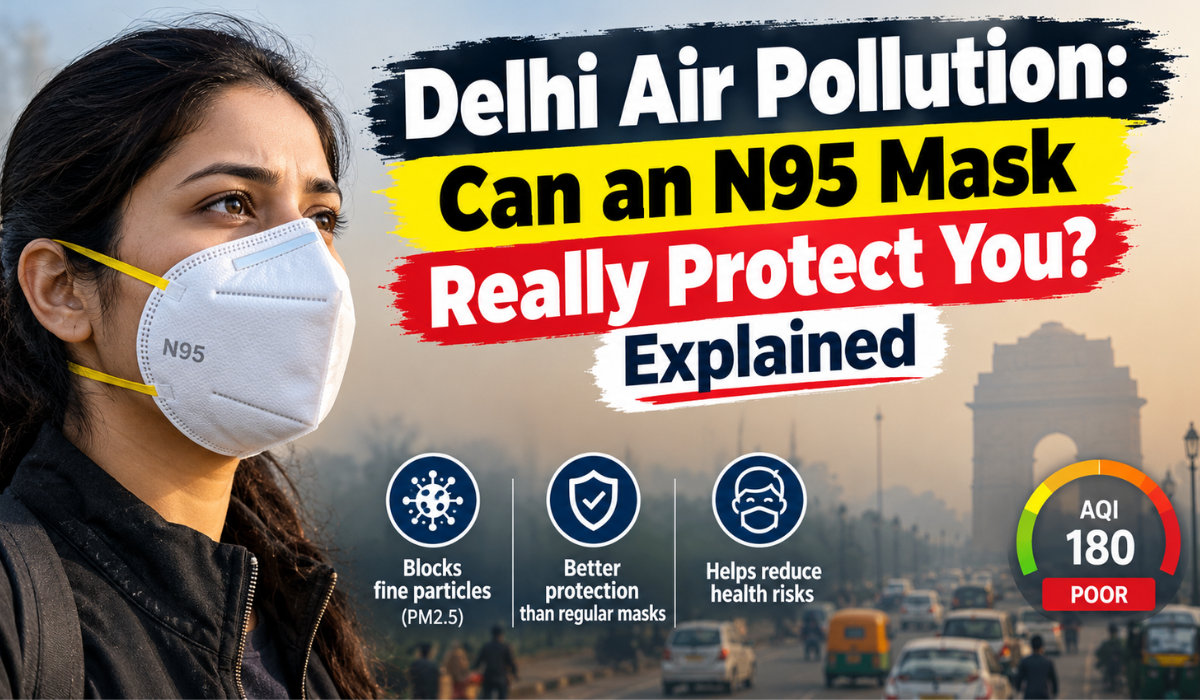
Delhi’s air pollution is once again raising health concerns, with the Air Quality Index (AQI) entering the ‘poor’ category. As pollution levels rise, one question is becoming increasingly important: Can wearing an N95 mask actually protect you from Delhi’s polluted air?
From commuters travelling to work to children going to school, exposure to polluted air can affect everyday life. The biggest concern is PM2.5, extremely fine particles that can penetrate deep into the lungs. However, wearing an N95 mask alone is not enough. If it does not fit properly, polluted air can enter through gaps.
Why Has Delhi’s Air Quality Worsened?
Delhi recorded its first ‘poor’ air quality reading of the season on October 21, with the AQI reaching 227 in the morning and climbing to 244 later in the day.
Following the deterioration, the Commission for Air Quality Management (CAQM) activated Stage One of the Graded Response Action Plan (GRAP) across Delhi-NCR.
The measures include action against road dust, construction-site dust and open waste burning. Weather conditions, including falling temperatures and changing wind speeds, can also affect how quickly pollutants disperse.
According to the Central Pollution Control Board (CPCB), an AQI between 201 and 300 falls in the ‘poor’ category. Prolonged exposure can cause breathing discomfort, particularly among people with existing health conditions. As winter approaches, unfavourable weather conditions can contribute to pollutant accumulation.
What Makes PM2.5 Dangerous?
PM2.5 refers to airborne particles measuring 2.5 micrometres or less in diameter. Their tiny size allows them to travel deep into the respiratory system.
Exposure can irritate the lungs, aggravate asthma and worsen existing respiratory conditions. Long-term exposure to fine-particle pollution is also associated with cardiovascular diseases, including heart disease and stroke.
Children, older adults, pregnant women, outdoor workers and people with existing heart or lung conditions require particular attention during pollution episodes.
Can an N95 Mask Protect You From Delhi’s Pollution?
A properly selected and well-fitted N95 respirator can reduce the amount of fine particulate pollution you inhale.
An N95 respirator is designed to filter at least 95 per cent of airborne particles under specified certification test conditions. However, this does not mean it removes 95 per cent of all pollution during everyday use.
Its effectiveness depends on the mask’s quality, fit and consistent use. Gaps around the nose, cheeks or chin can allow polluted air to bypass the filtering material.
The World Health Organization (WHO) recognises that respirators can reduce exposure to fine particles when selected and used correctly. However, masks cannot eliminate every pollution-related health risk. N95 respirators also do not protect against all harmful gases present in polluted air.
N95 vs N99: Which Mask Should You Choose?
Both respirators are designed to filter airborne particles, but their filtration ratings differ.
Although N99 offers a higher filtration rating, it does not automatically guarantee better real-world protection. A properly fitted N95 can be more effective than a higher-rated respirator that leaves gaps around the face.
How to Wear an N95 Mask Correctly
Even a suitable mask can offer reduced protection if worn incorrectly. Follow these precautions:
The US Centers for Disease Control and Prevention recommends checking the fit every time an N95 is worn. Facial hair where the respirator touches the skin can also interfere with the seal.
What Else Can You Do to Reduce Exposure?
A mask should not be your only line of defence against air pollution.
Check the AQI regularly through the CPCB’s official air-quality portal before planning outdoor activities. Avoid strenuous exercise and prolonged outdoor exposure when pollution levels are high.
Keep windows closed when outdoor pollution is severe, where practical, and minimise indoor smoke from cigarettes, incense and cooking. A properly sized air purifier with an appropriate particle filter can also help reduce indoor pollution.
People with existing heart or lung conditions should seek medical advice if they experience worsening symptoms. Severe breathlessness or chest pain requires prompt medical attention.
The Final Takeaway
As Delhi’s air quality deteriorates, a genuine, well-fitted N95 or N99 respirator can provide an additional layer of protection against fine particles. However, it cannot eliminate all health risks associated with polluted air.
Checking the AQI, limiting outdoor exertion and protecting vulnerable family members remain important precautions. Ultimately, masks can help reduce exposure, but sustained pollution-control measures are essential for cleaner air.
Imagine opening WhatsApp on your phone, but the SIM card linked to your account is not inside the...

Ladakh is seeing two changes at once: a new district has been announced, and the Centre has proposed...

What if a decision taken in Washington could influence India’s oil bills, export earnings and trade relations with...

What happens when the world’s richest business leaders clash over one of the world’s biggest internet markets? A...

Pakistan is heading into its wheat-growing season with a serious water problem. The country is facing a projected...

Imagine a foreign national standing among Indian citizens at a political protest, raising questions about the government or...

Aries: The day will be auspicious...