Last Updated: October 16, 2026
Last Updated: October 16, 2026





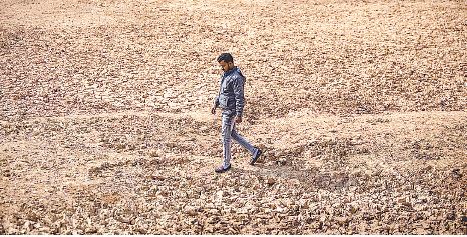
Deoria in eastern Uttar Pradesh has recorded the country’s steepest rainfall deficit this monsoon, with precipitation 87 per cent below normal, according to official data. The district received only 97.2 millimetres of rain by September 25 against the seasonal average of 759.4 mm, making 2025 its driest year in recent memory.
The deficit was consistent throughout the season. For the first eight weeks of the monsoon, rainfall was between 90 and 100 per cent below normal, while the following eight weeks registered shortfalls of 80 to 90 per cent. Mandhata Singh, chief scientist at the Krishi Vigyan Kendra in Deoria, said he had never seen such severe conditions in the district. He attributed the shortage to climate change, pointing out that a similar trend had been visible for the past three years.
The district has recorded significant rainfall deficits before, with a 43 per cent shortfall in 2024 and 46 per cent in 2023, although the years between 2020 and 2022 saw above-average monsoons. Farmers’ groups and opposition leaders have demanded that Deoria be declared drought-affected. The administration has yet to make such an announcement, possibly because most of the district’s agricultural land is irrigated, cushioning farmers from immediate disaster.
Even so, farmers warn of a sharp drop in yields. Rajkumar Singh, a farmer from Padrauna in neighbouring Kushinagar, said irrigation had not been enough to save rice crops from a 40 to 60 per cent fall in production. “We monitor the southwest monsoon every year. It is bypassing Purvanchal and moving forward,” he said.
The shortfall is not limited to Deoria. According to the India Meteorological Department (IMD), the 42 districts of eastern Uttar Pradesh received 16 per cent less rainfall than average this monsoon. Only Deoria and Kushinagar fell into the “large deficit” category, with Kushinagar posting a 64 per cent shortfall. Twenty-one of Purvanchal’s 33 districts were classified as rainfall-deficit areas, with shortages ranging between 20 and 59 per cent.
District-level data highlights the spread of the problem. In 2025, Gorakhpur recorded a 43 per cent deficit, Jaunpur 44 per cent, Mau 53 per cent, Sant Kabir Nagar 53 per cent, Azamgarh 40 per cent, Bhadohi 32 per cent, Siddharth Nagar 33 per cent, and several others between 20 and 39 per cent.
In contrast, western Uttar Pradesh received 12 per cent above-normal rainfall. Pilibhit was the only district there in the large-deficit category, with five others recording shortages.
Residents and experts say the pattern points to a longer-term shift. Singh and others believe climate change is reshaping rainfall across Purvanchal and even neighbouring Bihar, where farmers are reporting similar disruptions. While irrigation has prevented a drought declaration in Deoria, the continuing decline in rainfall underscores the growing vulnerability of the region to climate extremes.
Varanasi: A massive explosion triggered the collapse of a two-storey building in Uttar Pradesh’s Varanasi on Thursday, leaving...

Sofia: A vessel sailing under the flag of San Marino caught fire in the Black Sea near Romania...

New Delhi: Accusing the Congress of double-speak on women dignity, the Bharatiya Janata Party (BJP) Mahila Morcha on...

New Delhi: NITI Aayog’s Frontier Tech Hub released a Data Centre Evaluation Framework to help states plan for...
New Delhi: The Supreme Court on Thursday referred the cheque dishonour cases against actor and comedian Rajpal Yadav...

Mirzapur: Uttar Pradesh Chief Minister Yogi Adityanath on Thursday accused the Samajwadi Party (SP) and the Congress of...
Aries: The day will be auspicious...