Last Updated: October 18, 2026
Last Updated: October 18, 2026





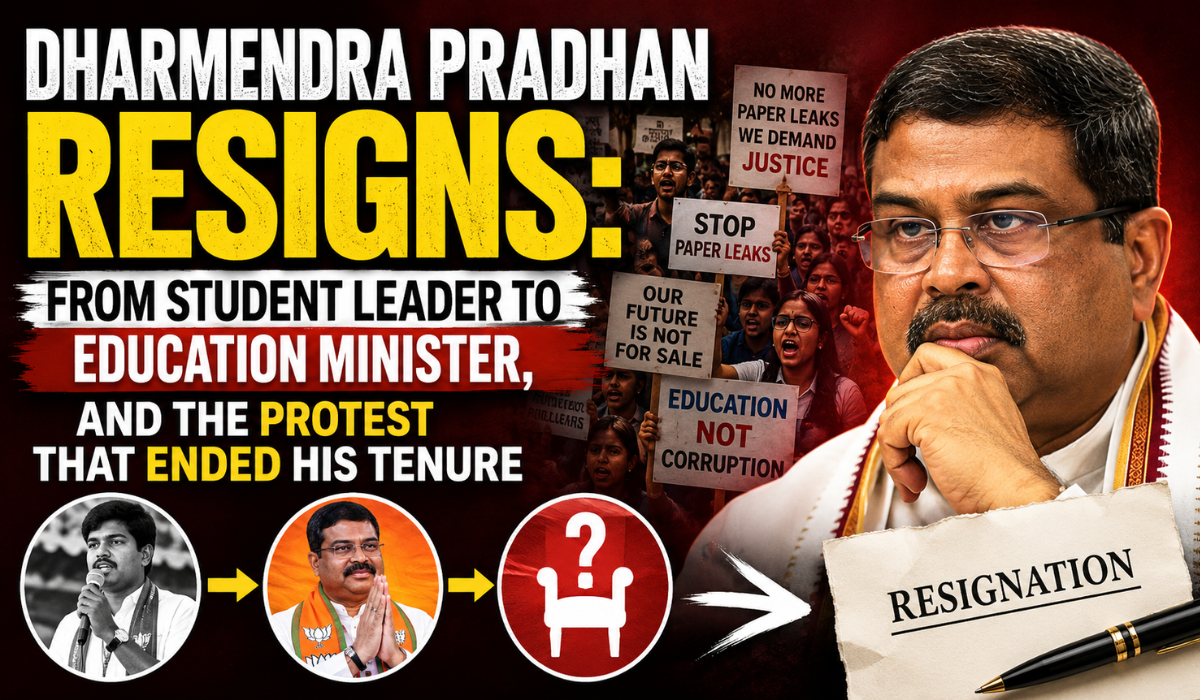
For nearly five years, Dharmendra Pradhan was the face of India’s education system. He led the implementation of the National Education Policy (NEP), expanded digital learning and promoted skill-based education. But in the end, it was a student-led movement that defined the final chapter of his tenure.
Following weeks of nationwide protests over the alleged NEET-UG 2026 paper leak, examination irregularities and growing demands for accountability, Pradhan resigned as Union Education Minister. The agitation, led by the Cockroach Janata Party (CJP) and supported by thousands of students, turned into one of the biggest youth movements seen in recent years.
So, who is Dharmendra Pradhan? What shaped his political journey? And what happens next for India’s education system?
A Political Career That Began with Student Activism
Interestingly, Dharmendra Pradhan’s own political journey started with student politics.
He began as an activist with the Akhil Bharatiya Vidyarthi Parishad (ABVP) in Odisha during the 1980s. He later became President of the Talcher College Students’ Union and served as National Secretary of the ABVP. His rise through student leadership gave him national political exposure before he formally joined the Bharatiya Janata Party (BJP) in 1998.
Over the next two decades, Pradhan steadily climbed the political ladder.
He served as an MLA in Odisha, represented the state in the Lok Sabha, entered the Rajya Sabha and later handled several key ministries, including Petroleum and Natural Gas, Steel, and Skill Development. His work on schemes like Ujjwala Yojana and skill development programmes made him one of the BJP’s prominent faces.
In July 2021, he took charge as Union Education Minister, becoming responsible for implementing one of India’s biggest education reforms.
What Defined His Time as Education Minister?
Pradhan’s tenure saw several major policy initiatives.
The biggest was the implementation of the National Education Policy (NEP) 2020. The policy aimed to make education more flexible, multidisciplinary and skill-oriented while encouraging learning in regional languages during the early years.
He also launched the PM SHRI Schools initiative to transform thousands of government schools into model institutions with modern infrastructure and digital classrooms.
Digital education received another push through platforms such as DIKSHA and SWAYAM, while vocational education was increasingly integrated into mainstream schooling.
On paper, these reforms reflected a long-term vision for India’s education sector.
The Controversies That Overshadowed the Reforms
Despite these initiatives, Pradhan’s tenure became increasingly associated with problems surrounding national entrance examinations.
Questions were repeatedly raised over the functioning of the National Testing Agency (NTA), which conducts major examinations including NEET, CUET and UGC-NET.
The 2024 NEET controversy had already sparked legal and political debates over alleged paper leaks, grace marks and examination management.
However, the situation escalated sharply in 2026 after fresh allegations of irregularities in NEET-UG triggered widespread outrage among students and parents.
As pressure mounted, the examination process came under intense public scrutiny, leading to renewed demands for accountability and structural reforms.
How the CJP Protest Changed the Political Narrative
What began as student anger soon evolved into a national protest movement.
The Cockroach Janata Party (CJP), which emerged as the face of the agitation, organised continuous demonstrations, sit-ins and marches centred around demands for fair examinations and greater accountability.
Thousands of students gathered at Delhi’s Jantar Mantar, while protests spread to multiple states.
The movement gradually shifted beyond the NEET examination itself. It became a broader conversation about transparency, examination security, youth unemployment and trust in public institutions.
Opposition parties also backed demands for ministerial accountability, increasing political pressure on the government.
Eventually, the pressure became too significant to ignore, culminating in Dharmendra Pradhan’s resignation.
What Happens Next?
Pradhan’s resignation may ease immediate political pressure, but it does not solve the larger problems facing India’s examination system.
The biggest challenge now is restoring students’ confidence.
The government is expected to accelerate reforms within the National Testing Agency by strengthening cybersecurity, improving question paper security, increasing transparency in examinations and introducing stronger monitoring mechanisms.
Students and parents will also closely watch whether future entrance examinations can be conducted without controversy.
At the policy level, the implementation of NEP 2020 is expected to continue, but under new political leadership.
Why This Resignation Matters
Dharmendra Pradhan’s exit is politically significant for another reason.
His career began as a student activist fighting for student issues.
Years later, he leaves office after facing one of the country’s largest student-led protest movements.
That contrast has become the defining narrative of his political journey.
While his supporters will remember his role in implementing major education reforms, critics argue that repeated examination controversies overshadowed those achievements.
Ultimately, the future of India’s education system will depend not only on new leadership but also on whether examination reforms can rebuild public trust.
Because for millions of students, the real issue has never been about one minister. It has always been about one simple expectation—that every examination should be fair, transparent and free from doubt.
What if a decision taken in Washington could influence India’s oil bills, export earnings and trade relations with...

What happens when the world’s richest business leaders clash over one of the world’s biggest internet markets? A...

Pakistan is heading into its wheat-growing season with a serious water problem. The country is facing a projected...

Imagine a foreign national standing among Indian citizens at a political protest, raising questions about the government or...

For thousands of Indian tech workers in the United States, a job offer is only the beginning of...

Three years ago, on October 7, 2023, Israel woke up to one of the deadliest attacks in its...