Last Updated: October 26, 2026
Last Updated: October 26, 2026





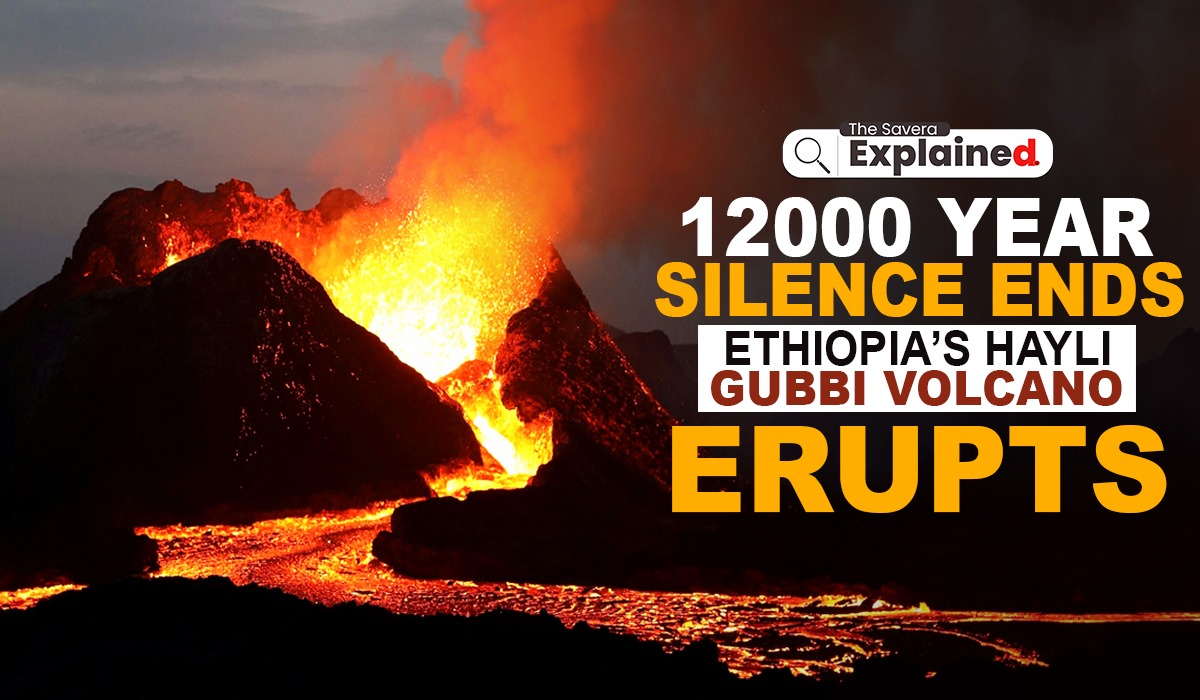
It began without warning — a silent desert mountain suddenly spoke after 12,000 years.
On November 23, 2025, the Hayli Gubbi volcano in eastern Ethiopia erupted for the first time in recorded history. Deep inside the remote Afar region, near the border with Eritrea, the long-dormant volcano exploded with force, sending ash and gas shooting nearly 14 kilometers into the sky.
There were no lava rivers, but the blast lasted for hours, covering nearby villages like Afdera in thick gray dust.
The volcano lies about 800 kilometers northeast of Addis Ababa. Though no deaths were reported, local herders fear for their livestock, and crops and water sources have been coated in ash. Experts say the eruption has paused, but the area remains under close watch due to the region’s active geology.
What Happened at Hayli Gubbi?
The Afar region sits on the East African Rift, where the continent is slowly splitting apart. This makes it one of the most volcanically active places on Earth. Hayli Gubbi is only 15 kilometers away from Erta Ale, which erupted earlier in July 2025.
Eyewitnesses described the eruption as “like a sudden bomb.” Instead of lava flowing out, trapped gases exploded upward, breaking the magma into fine ash made of rock, glass, and minerals. The ash rose high enough to catch strong winds, turning a local eruption into an international problem. No clear warning signs were detected before the blast, showing how unpredictable ancient volcanoes can be.
Why Was There Ash but No Lava?
Not all volcanoes behave the same way. At Hayli Gubbi, the magma was thick and sticky, rich in silica. This type of magma traps gases inside it. As pressure built and the magma rose toward the surface, the gases could not escape slowly. Instead, they burst out violently, breaking the magma into fine ash.
In contrast, volcanoes with runny magma allow gases to escape easily, leading to slow and steady lava flows. At Hayli Gubbi, the trapped gases exploded before molten rock could flow out, which is why a tall ash plume formed and no lava flow was seen at the surface.
How the Ash Traveled So Far
By November 24, satellite images from NASA and the Copernicus Programme showed the ash drifting east across the Red Sea. It reached Yemen and Oman, and then moved toward Pakistan by late November 24.
On November 25, the plume entered India. Flights were disrupted because volcanic ash is dangerous for jet engines — it can melt inside turbines and cause engine failure. Air India canceled 11 flights, and the Directorate General of Civil Aviation warned airlines to avoid ash-affected airspace. Several flights to and from Hyderabad were grounded.
The ash cloud is expected to move toward Bangladesh, Myanmar, China, and possibly southern Japan by November 26.
Why This Eruption Matters
Locally, people face breathing problems, polluted water, and risks to livestock. Regionally, flights were disrupted across several countries. Globally, the event shows how connected our skies are — fine ash from a remote desert can travel thousands of kilometers in just a few days.
Hayli Gubbi is a reminder that even quiet, ancient volcanoes can erupt suddenly, affecting lives far beyond their borders.
Imagine opening WhatsApp on your phone, but the SIM card linked to your account is not inside the...

Delhi’s air pollution is once again raising health concerns, with the Air Quality Index (AQI) entering the ‘poor’...

Ladakh is seeing two changes at once: a new district has been announced, and the Centre has proposed...

What if a decision taken in Washington could influence India’s oil bills, export earnings and trade relations with...

What happens when the world’s richest business leaders clash over one of the world’s biggest internet markets? A...

Pakistan is heading into its wheat-growing season with a serious water problem. The country is facing a projected...

Aries: The day will be auspicious...