Last Updated: October 6, 2026
Last Updated: October 6, 2026





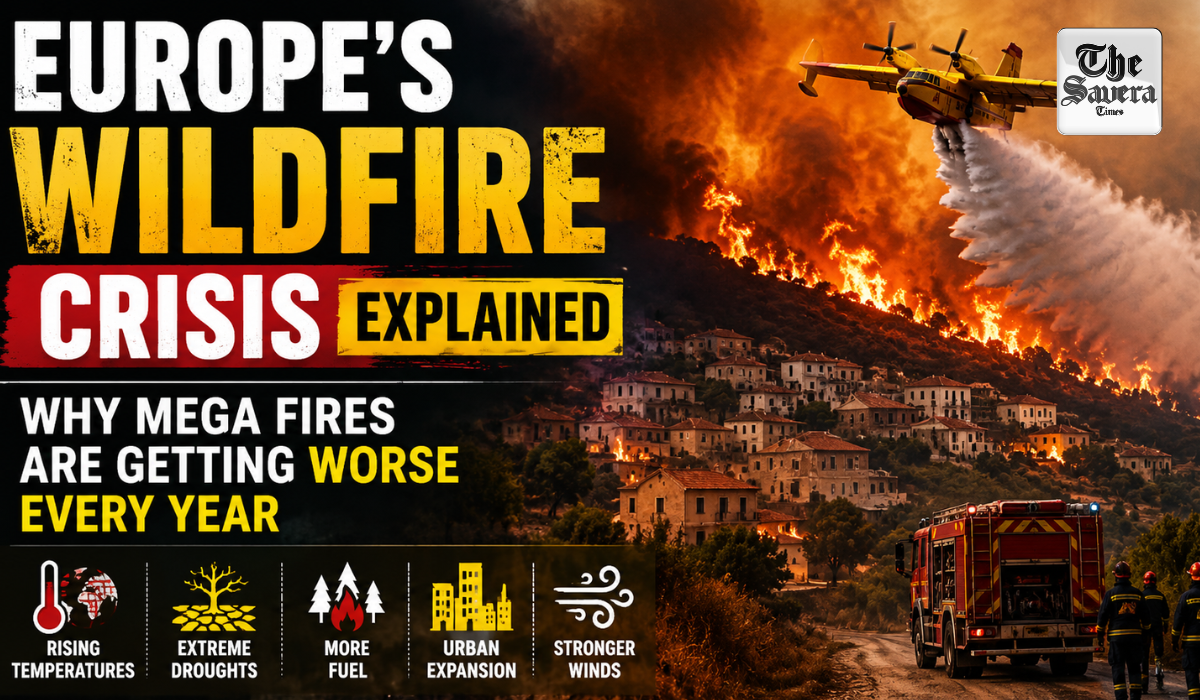
Europe is burning again. From Greece and France to Spain and Portugal, massive wildfires are destroying forests, forcing hundreds of thousands of people to flee, and stretching firefighters to their limits.
What makes this year different is not just the number of fires, but their size, speed and intensity. Scientists say Europe is witnessing a new era of “mega-fires” driven by record-breaking heat, prolonged drought and changing weather patterns. So, why are these wildfires becoming so dangerous? And can Europe stop them?
Europe’s Worst Fire Season in Years
Southern Europe is currently facing one of its most severe wildfire seasons in recent history. Greece remains the worst-hit country, while France, Spain and Portugal are also battling major blazes.
According to the European Forest Fire Information System (EFFIS), nearly 4.35 lakh hectares of land have already burned across the European Union this year. That is more than double the long-term average. Around 1,400 wildfires have been detected, but experts say there are fewer fires than usual that are growing into much larger “mega-fires.” Carbon emissions from these fires have already reached nearly 18 million tonnes, showing the enormous environmental impact.
Why Are Europe’s Wildfires Becoming Worse?
The biggest reason is extreme heat.
Several countries have witnessed repeated heatwaves with temperatures crossing 40 degrees Celsius for weeks. When the weather stays extremely hot for a long time, forests, grasslands and shrubs become extremely dry. This dry vegetation becomes perfect fuel for fires.
The second reason is severe drought. Many parts of southern Europe have received very little rainfall over the past several months. Dry soil and dry forests allow flames to spread rapidly.
The third factor is strong winds.
In Greece, wind speeds have reached over 100 kilometres per hour, making it extremely difficult to control fires. Winds carry burning embers over long distances, creating new fires far away from the original blaze.
Scientists also point to climate change. Europe is now the fastest-warming continent, with rising temperatures increasing both the length and intensity of wildfire seasons.
Why Are These Fires Harder to Stop?
Modern wildfires behave very differently from those seen a decade ago.
Today’s fires burn hotter, spread faster and often create their own weather systems. Extremely intense fires can produce giant smoke clouds known as pyrocumulonimbus, which generate powerful winds and even lightning, making firefighting even more dangerous.
Firefighters also face difficult terrain such as mountains, forests and islands. Strong winds often prevent helicopters and water-dropping aircraft from operating safely.
In Greece, nearly 500 firefighters, supported by teams from France and Romania, have been deployed, while aircraft continue water-bombing operations whenever weather permits.
The Human and Environmental Cost
The impact goes far beyond burnt forests.
Thousands of homes have been destroyed, tourism has been severely disrupted and agricultural land has been damaged.
This year alone, more than 300,000 people have been evacuated across Europe due to wildfire threats.
Wildfires also release massive amounts of carbon dioxide into the atmosphere, worsening global warming and creating a dangerous cycle where hotter temperatures lead to even more fires in future years. Smoke from these fires affects air quality hundreds of kilometres away and increases health risks, especially for children and older people.
Recent Wildfire Disasters
Europe has experienced several devastating wildfire seasons in recent years.
In 2023, Greece witnessed one of the largest wildfires ever recorded in the European Union in the Evros region.
In 2025, the EU recorded its most destructive wildfire season on record, with more than one million hectares burned across member states.
Now in 2026, France has already recorded its worst wildfire season in history, while Spain has seen some of its largest fires on record. Greece continues to battle dozens of active blazes across the mainland and islands, including Crete.
Europe’s Response to the Wildfire Emergency
European countries are working together through the EU Civil Protection Mechanism, which allows firefighters, aircraft and emergency equipment to be shared across borders.
The EU has also deployed firefighting planes under the rescEU programme and uses the Copernicus Emergency Management Service to monitor fires through satellites in real time.
Countries are issuing evacuation orders much earlier, investing in forest management, creating firebreaks and improving early warning systems. However, experts say emergency response alone is no longer enough without stronger climate adaptation measures.
The Bigger Picture
Europe’s wildfire crisis is no longer just a summer emergency. It is becoming a climate emergency.
Longer heatwaves, rising temperatures, prolonged droughts and stronger winds are creating conditions where forests ignite more easily and fires become almost impossible to contain.
Unless greenhouse gas emissions are reduced and climate resilience improves, scientists warn that Europe’s wildfire seasons are likely to become even longer, larger and more destructive in the years ahead.
Imagine being seriously injured inside a flying aircraft, with blood on your clothes, passengers in panic and the...

Imagine the world’s biggest diesel exporter turning off its export taps. That is the concern after US President...

For India’s pharmaceutical industry, the latest US tariff decision brings relief — but not across the entire medicines...

One handshake, two superpowers and a long list of disagreements. US President Donald Trump and Chinese President Xi...

A river does not understand borders. But when two countries sharing that river are locked in a long-running...

A voter list revision — and now a software controversy A voter may have the right to vote,...

Aries: The day will be auspicious...