Last Updated: October 17, 2026
Last Updated: October 17, 2026





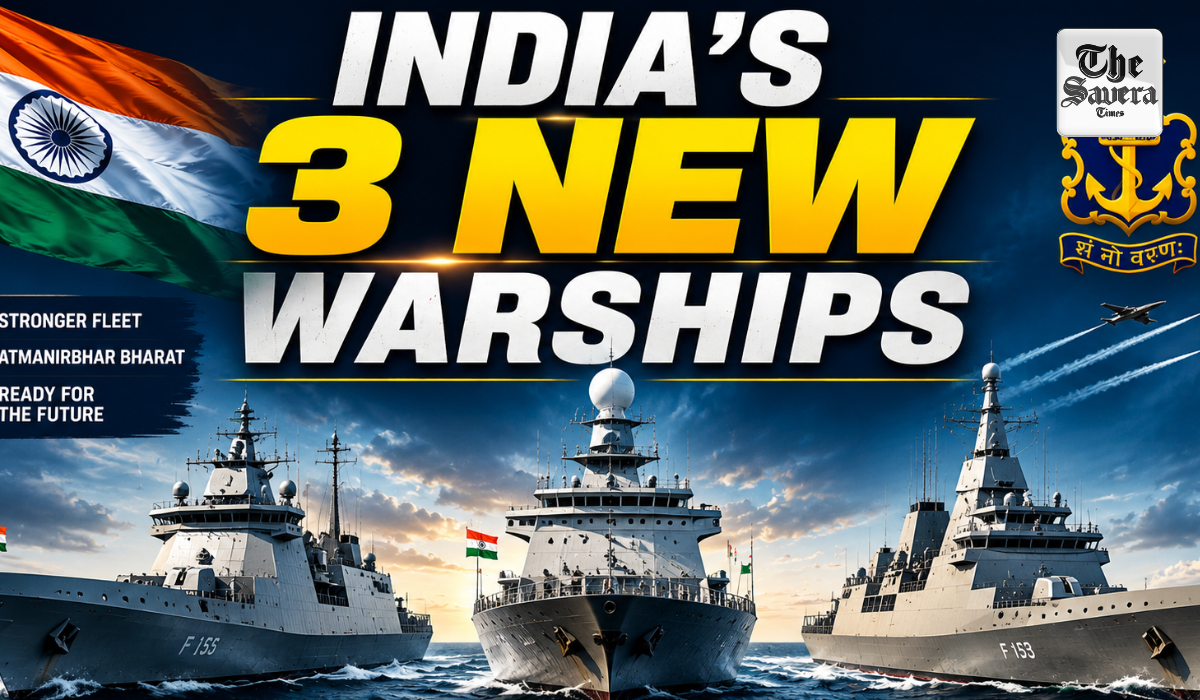
Three ships. Three very different missions. One clear message.
As India faces growing maritime challenges in the Indian Ocean, the Indian Navy has inducted three new indigenous vessels — INS Dunagiri, INS Sanshodhak, and INS Agray.
One is built to fight enemy warships far out at sea.
One is designed to map and understand the oceans.
And one is a specialist submarine hunter that protects India’s coastline.
Together, these ships strengthen India’s maritime power and reinforce the country’s push towards defence self-reliance.
So what exactly are these ships, and why are they important?
Why This Commissioning Matters
Prime Minister Narendra Modi commissioned all three ships together in Kolkata on June 21.
Built by Garden Reach Shipbuilders and Engineers, or GRSE, the vessels have more than 75 percent indigenous content and involve over 200 Indian MSMEs.
But this is not just about adding new ships.
It is about strengthening three different layers of maritime security at the same time.
One ship protects India in deep oceans.
One helps India understand the seas better.
And one guards coastal waters from underwater threats.
Together, they strengthen India’s maritime security architecture.
INS Dunagiri: The Ocean Warrior
INS Dunagiri is the largest and most powerful of the three.
A stealth-guided missile frigate under Project 17A, it is designed to operate far from India’s coastline.
It can fight enemy ships, defend against aerial threats, and hunt submarines.
The ship carries BrahMos supersonic cruise missiles, advanced air defence systems, radar, sonar, and electronic warfare equipment.
Its stealth design makes it harder for enemy radars and sensors to detect.
Why does this matter?
Because India’s strategic interests now extend across the Arabian Sea, Bay of Bengal, and the wider Indian Ocean.
INS Dunagiri gives the Navy greater reach and combat capability in distant waters.
Simply put, it is India’s deep-sea combat platform.
INS Sanshodhak: The Ship That Studies The Sea
The second ship may not look like a warship, but its role is critical.
INS Sanshodhak is a Survey Vessel Large.
Its job is to map ocean depths, study the seabed, survey navigation routes, and collect oceanographic data.
This information helps warships and submarines operate safely and effectively.
The shape of the seabed, underwater channels, currents, and coastal features all influence naval operations.
The vessel is equipped with advanced systems, including multi-beam echo sounders, autonomous underwater vehicles, and remotely operated vehicles.
Beyond defence, it also supports civilian shipping, marine research, disaster response, and coastal development.
If Dunagiri is the fighter, Sanshodhak is the scientist.
INS Agray: The Submarine Hunter
The smallest of the three, INS Agray has a highly specialised mission.
It belongs to the Arnala-class of Anti-Submarine Warfare Shallow Water Crafts.
Its role is straightforward — find submarines, track them, and if necessary, destroy them.
Unlike large warships, Agray operates close to the coastline.
These waters are crowded with fishing boats, commercial vessels, and underwater obstacles, making submarine detection extremely difficult.
To tackle this challenge, Agray is equipped with sonar systems, lightweight torpedoes, and anti-submarine rocket launchers.
As neighbouring countries expand their submarine fleets, platforms like Agray are becoming increasingly important for coastal security.
The Bigger Strategic Message
The simultaneous induction of these three ships reflects a layered naval strategy.
Dunagiri provides combat power in the open ocean.
Sanshodhak improves maritime awareness and understanding of the underwater environment.
Agray strengthens coastal defence against submarine threats.
As the Indian Ocean becomes increasingly strategic, and as China and Pakistan continue to expand their maritime capabilities, India needs ships that can fight, gather information, and protect the coastline.
These three vessels deliver exactly that.
Conclusion
INS Dunagiri, INS Sanshodhak, and INS Agray may have different missions, but together they tell one story.
India is not just buying military hardware anymore.
It is building it.
One ship fights.
One ship studies.
One ship protects.
And together, they make India’s maritime shield stronger than ever.
What if a decision taken in Washington could influence India’s oil bills, export earnings and trade relations with...

What happens when the world’s richest business leaders clash over one of the world’s biggest internet markets? A...

Pakistan is heading into its wheat-growing season with a serious water problem. The country is facing a projected...

Imagine a foreign national standing among Indian citizens at a political protest, raising questions about the government or...

For thousands of Indian tech workers in the United States, a job offer is only the beginning of...

Three years ago, on October 7, 2023, Israel woke up to one of the deadliest attacks in its...