Last Updated: October 26, 2026
Last Updated: October 26, 2026





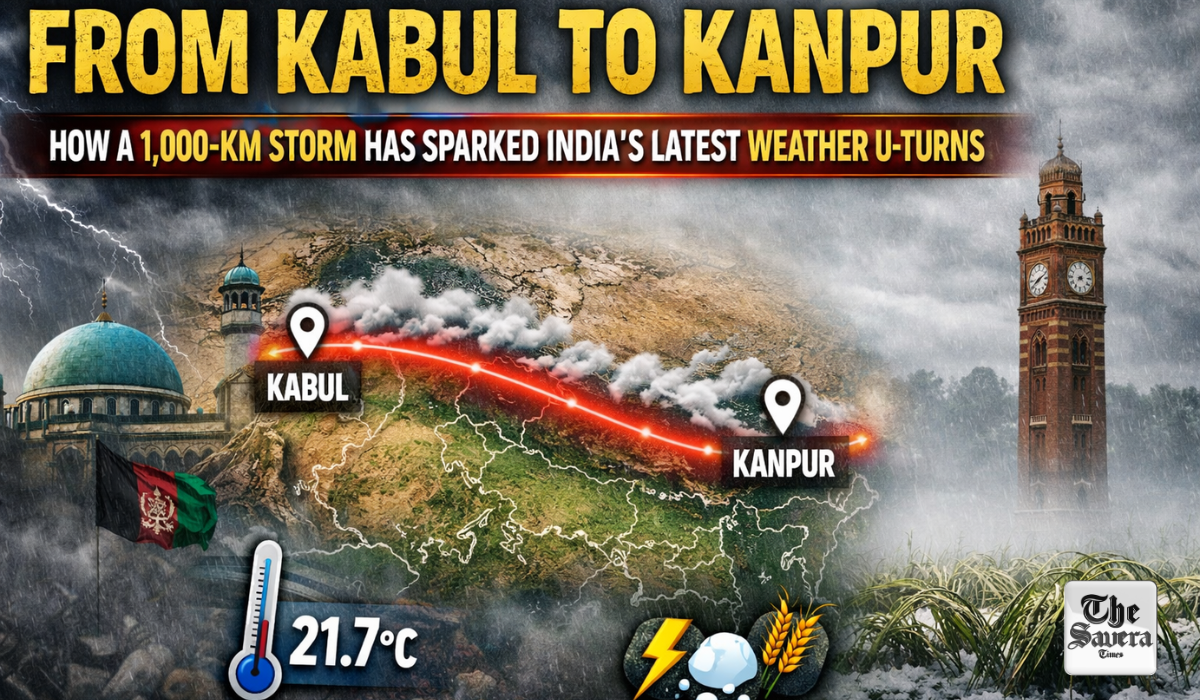
A sweeping, 1,000‑kilometre long atmospheric storm band stretching from Afghanistan through Pakistan into northern and central India has upended seasonal expectations, effectively delaying the onset of summer and bringing unseasonal rain, thunderstorms, hail, and a sharp temperature drop across much of North India.
This unusually linear rain band — part of an active Western Disturbance — is a rare structural phenomenon that has caused intense weather far beyond typical winter systems.
What Is This 1,000‑Km Weather Band?
Western Disturbances are weather systems originating near the Mediterranean that normally travel in slightly curved arcs, weakening as they spread moisture and winds over the region. But this particular disturbance has taken on a straight, elongated profile, allowing it to funnel moisture directly over vast distances with greater intensity than usual.
This geometry acts as a force multiplier, concentrating wind energy and humidity into a narrow corridor that has delivered heavy rain, thunderstorms, gusty winds (40‑80 km/h), and isolated hailstorms across parts of Afghanistan, Pakistan, and India.
Meteorologists say this extended band has tapped moisture not only from the Mediterranean and Caspian region but also from the Arabian Sea, supercharging storm activity when it reached the Indo‑Gangetic plains.
Cold Spell in Delhi and Northern Plains
In key urban centres like New Delhi, the impact was dramatic. Residents recorded unseasonal cool conditions — with maximum temperatures dipping well below the monthly average and thick cloud cover limiting daytime warming — reminiscent of mid‑winter rather than late March. Alongside storm activity, dense fog and much improved air quality were reported as heavy rain cleared particulates from the atmosphere.
Agricultural and Economic Fallout
While relief from heat was welcome in cities, the storm posed risks for the agrarian heartland. The heavy rains and strong gusts arrived during a critical harvest period for rabi crops such as wheat, mustard, and gram across states like Punjab, Haryana, Rajasthan and Uttar Pradesh.
Sustained wet spells and hail have already caused crop lodging — where mature, moisture‑heavy stalks bend or break — heightening concerns about potential agricultural losses, yield impacts, and future food inflation pressures.
Climate Patterns and Future Outlook
Climatologists are increasingly viewing this event in the context of shifting seasonal boundaries, where Western Disturbances persist later into March than is typical, due to broader changes in atmospheric circulation patterns.
The India Meteorological Department (IMD) has issued alerts for continuing rain, thunderstorms and gusty winds across broad regions, and has forecast that additional disturbances may follow later this month, prolonging erratic and unpredictable weather ahead of the monsoon transition.
Imagine opening WhatsApp on your phone, but the SIM card linked to your account is not inside the...

Delhi’s air pollution is once again raising health concerns, with the Air Quality Index (AQI) entering the ‘poor’...

Ladakh is seeing two changes at once: a new district has been announced, and the Centre has proposed...

What if a decision taken in Washington could influence India’s oil bills, export earnings and trade relations with...

What happens when the world’s richest business leaders clash over one of the world’s biggest internet markets? A...

Pakistan is heading into its wheat-growing season with a serious water problem. The country is facing a projected...

Aries: The day will be auspicious...