Last Updated: October 26, 2026
Last Updated: October 26, 2026





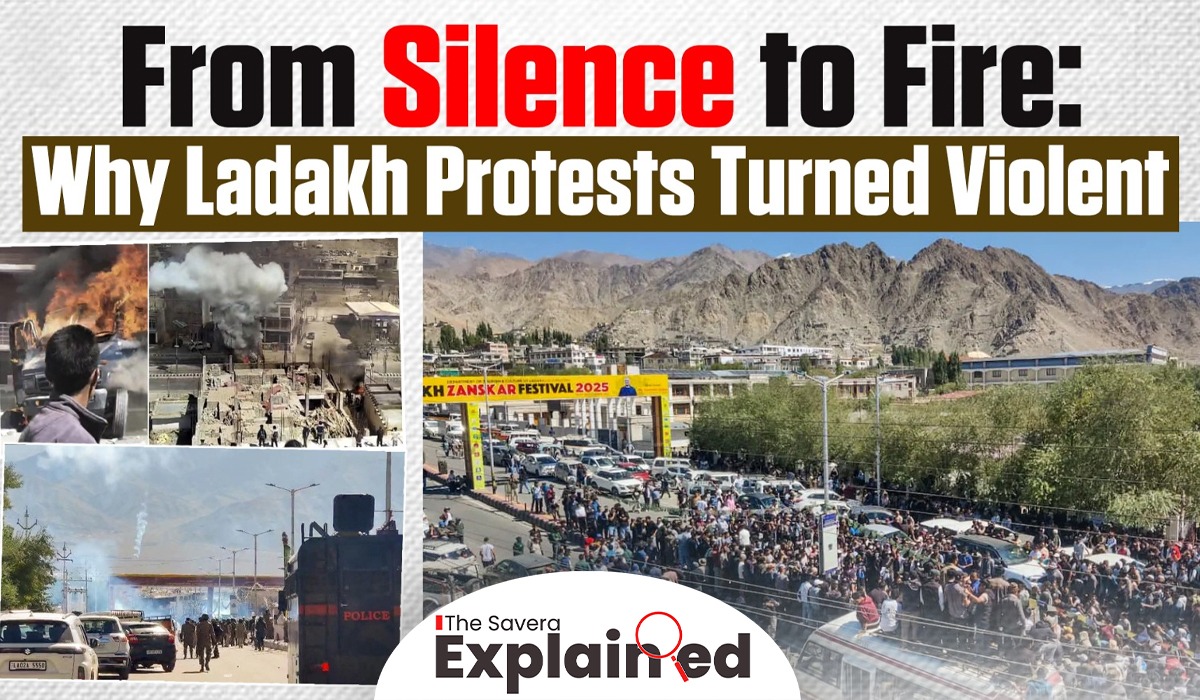
Leh, Ladakh: On September 24, 2025, peaceful protests in Ladakh turned violent, leading to four deaths and over 80 injuries. Protesters clashed with police in Leh, setting fire to the BJP office and a police vehicle.
This marked the worst unrest in the region since it became a Union Territory in 2019. But what triggered this unrest?
To understand this, let’s go back to the background. In August 2019, the Indian government ended special status for Jammu and Kashmir under Article 370.
It split the state into two Union Territories: Jammu and Kashmir, and Ladakh. Unlike Jammu and Kashmir, Ladakh has no elected assembly and is ruled directly by the central government through a Lieutenant Governor.
At first, many in Ladakh welcomed the change. But soon, people began to worry about losing control over their land, jobs, and environment. Ladakh is a cold desert with a fragile ecosystem and a mostly tribal population.
Without protections, large-scale projects could harm the region and bring in outsiders, threatening both local livelihoods and the environment.
The key demands of Ladakh’s people include statehood with its own legislature, inclusion in the Sixth Schedule of the Constitution for tribal autonomy, separate Parliament seats for Leh and Kargil districts, and job reservations for locals. Two main groups have led this movement: the Leh Apex Body (LAB) and the Kargil Democratic Alliance (KDA). In 2023, they formed a High-Powered Committee with the government to discuss these issues. While talks were held, progress stalled after May 2025. Only a domicile policy for jobs was agreed upon, leaving other major demands unmet.
What Happened Leading to Violence
Frustration built up over time. In September 2025, climate activist Sonam Wangchuk and others began a hunger strike on September 10. The strike lasted 35 days for some protesters, with demands for urgent action on statehood and constitutional protections. On September 24, two elderly hunger strikers, aged 72 and 60, were hospitalized in critical condition. This triggered anger among young protesters, often referred to as Gen Z in reports. They gathered outside the BJP office in Leh during a shutdown called by the Leh Apex Body.
The protest quickly escalated into violence. Crowds threw stones at police and set fires. Police responded with teargas, batons, and, according to some accounts, gunfire in self-defense. Four young protesters were killed, aged between 19 and 46, while more than 40 police personnel were injured. Violence also spread to the Hill Council office.
The immediate triggers were the health crisis of hunger strikers, years of joblessness among the youth, and delays in government talks.
Why It Turned Violent
The shift from peaceful protest to violence has been explained in different ways. Protesters describe it as an outburst from frustrated youth who face unemployment and feel their demands have been ignored. Sonam Wangchuk called it the saddest day for Ladakh and ended his hunger strike, urging a return to non-violence.
The government, on the other hand, blames provocative speeches by leaders, including Wangchuk, saying they incited the crowd. Officials have also described it as part of a larger conspiracy, drawing comparisons to Gen Z uprisings in Bangladesh and Nepal. The BJP has accused opposition parties such as Congress of fueling the unrest, while Congress has placed responsibility on the central government for failing to manage the talks effectively.
At present, a curfew is in place in Leh district. Authorities have banned gatherings under Section 163 of the Bharatiya Nagarik Suraksha Sanhita, and additional forces from the CRPF have been deployed to restore order. Calm returned by the afternoon of September 24, but tensions remain high.
Recent developments include the government scheduling the next High-Powered Committee meeting for October 6, 2025, along with additional talks on September 25 and 26. Activists insist that quick resolutions are necessary to prevent further escalation. Meanwhile, the annual Ladakh festival was canceled in the aftermath of the violence.
Ladakh’s people continue to seek safeguards for their future. The violent turn of the protests underscores deep frustrations, but leaders from both sides are now calling for dialogue to find a way forward.
Imagine opening WhatsApp on your phone, but the SIM card linked to your account is not inside the...

Delhi’s air pollution is once again raising health concerns, with the Air Quality Index (AQI) entering the ‘poor’...
Ladakh is seeing two changes at once: a new district has been announced, and the Centre has proposed...
What if a decision taken in Washington could influence India’s oil bills, export earnings and trade relations with...

What happens when the world’s richest business leaders clash over one of the world’s biggest internet markets? A...

Pakistan is heading into its wheat-growing season with a serious water problem. The country is facing a projected...
Aries: The day will be auspicious...