Last Updated: October 26, 2026
Last Updated: October 26, 2026





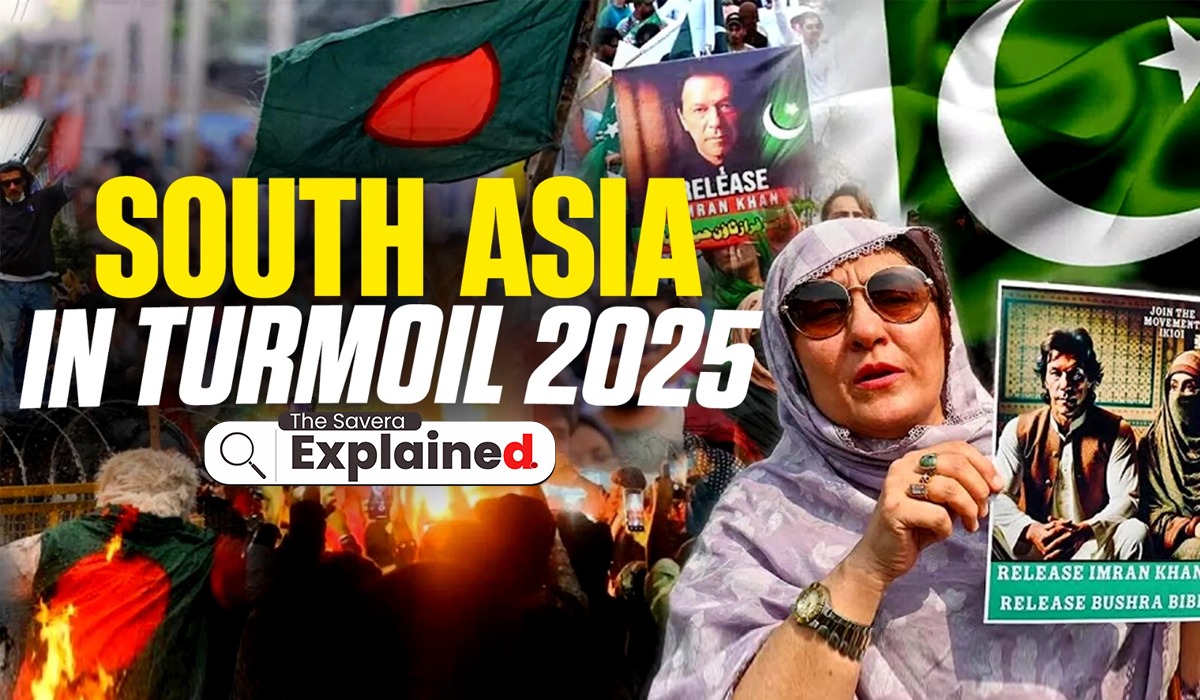
In 2025, India’s neighbourhood did not face a single defining war or external shock. Instead, the region witnessed a series of internal breakdowns — governments shaken by protests, political systems paralysed by distrust, and humanitarian crises exposing weak state capacity.
From Nepal to Bangladesh, Pakistan to Afghanistan, the pattern was unmistakable: the pressure on states came from their own streets, institutions and policy choices.
For India, watching these developments was not just about regional concern, but about understanding how quickly legitimacy can erode in young, restless societies.
Bangladesh: A transition trapped in turbulence
Bangladesh entered 2025 still reeling from the dramatic removal of Prime Minister Sheikh Hasina in 2024. An interim government led by Nobel laureate Muhammad Yunus promised stability and elections in 2026, but the year proved anything but calm.
In November, Hasina was sentenced to death in absentia by the International Crimes Tribunal for alleged crimes linked to the 2024 student uprising. She also received a separate 21-year sentence in corruption cases, while her children were jailed. Hasina, now in India, rejected the rulings as politically motivated.
The crisis deepened after the assassination of Sharif Osman Hadi, a 32-year-old youth leader and key figure of the uprising. His killing triggered nationwide riots, attacks on Awami League offices and assaults on major media houses. Streets across Dhaka and other cities filled with protesters demanding justice.
Violence soon spilled into communal tensions. A Hindu youth, Dipu Chandra Das, was lynched over blasphemy allegations, raising fears among minority communities. Days later, another youth leader survived a targeted shooting.
Bangladesh now stands at a fragile crossroads — attempting democratic renewal amid political violence, social unrest and uncertainty over who will lead next.
Nepal: Youth anger topples a prime minister
Nepal witnessed one of its most powerful youth-led movements in decades — and it succeeded in bringing down a government.
The unrest began after the government blocked 26 major social media platforms for failing to register locally. For a digitally dependent generation, the ban was seen as an attack on free speech and livelihoods.
What began as peaceful protests turned deadly after police opened fire, killing at least 19 people. Demonstrators breached restricted zones, torched government buildings and forced the temporary shutdown of Kathmandu’s international airport. Online campaigns exposed corruption and elite privilege, rapidly amplifying anger.
Under mounting pressure, Home Minister Ramesh Lekhak resigned, followed by Prime Minister KP Sharma Oli. An interim government led by former chief justice Sushila Karki was formed — a rare example of youth mobilisation directly reshaping political power.
Pakistan: Politics inside prison walls
Pakistan’s turmoil unfolded through courtrooms and jails. Former Prime Minister Imran Khan and his wife Bushra Bibi were sentenced to 17 years in prison in the Toshakhana corruption case. Khan rejected the verdict, calling it politically engineered, and blamed army chief Asim Munir.
Restrictions on access to Khan inside Adiala Jail sparked protests led by his supporters and sisters. Police crackdowns, arrests and allegations of abuse further escalated tensions. The episode highlighted Pakistan’s long-standing struggle — a political system trapped in conflict between courts, the military and elected leaders.
Afghanistan: Disaster meets policy limits
Afghanistan faced one of its deadliest earthquakes, killing more than 2,200 people. While the Taliban mobilised forces and relief camps, rescue efforts were slowed by damaged infrastructure and difficult terrain.
Restrictions on women worsened the crisis. With most healthcare workers being male, injured women and girls struggled to access timely medical care, exposing how governance decisions can deepen humanitarian suffering.
Sri Lanka and Myanmar: Quiet but deep crises
Sri Lanka was hit by devastating floods after Cyclone Ditwah. Despite early warnings, poor coordination and communication failures left millions affected, revealing gaps in disaster preparedness.
In Myanmar, instability was less visible but deeply entrenched. Aung San Suu Kyi remains imprisoned and isolated, serving a 27-year sentence. Her continued silence reflects the collapse of institutions since the 2021 military coup.
The takeaway for India
Across South Asia, 2025 showed that internal stress is now the biggest driver of instability. Youth alienation, weak institutions and governance failures can unravel nations faster than any external threat.
Imagine opening WhatsApp on your phone, but the SIM card linked to your account is not inside the...

Delhi’s air pollution is once again raising health concerns, with the Air Quality Index (AQI) entering the ‘poor’...
Ladakh is seeing two changes at once: a new district has been announced, and the Centre has proposed...
What if a decision taken in Washington could influence India’s oil bills, export earnings and trade relations with...

What happens when the world’s richest business leaders clash over one of the world’s biggest internet markets? A...

Pakistan is heading into its wheat-growing season with a serious water problem. The country is facing a projected...
Aries: The day will be auspicious...