Last Updated: October 26, 2026
Last Updated: October 26, 2026





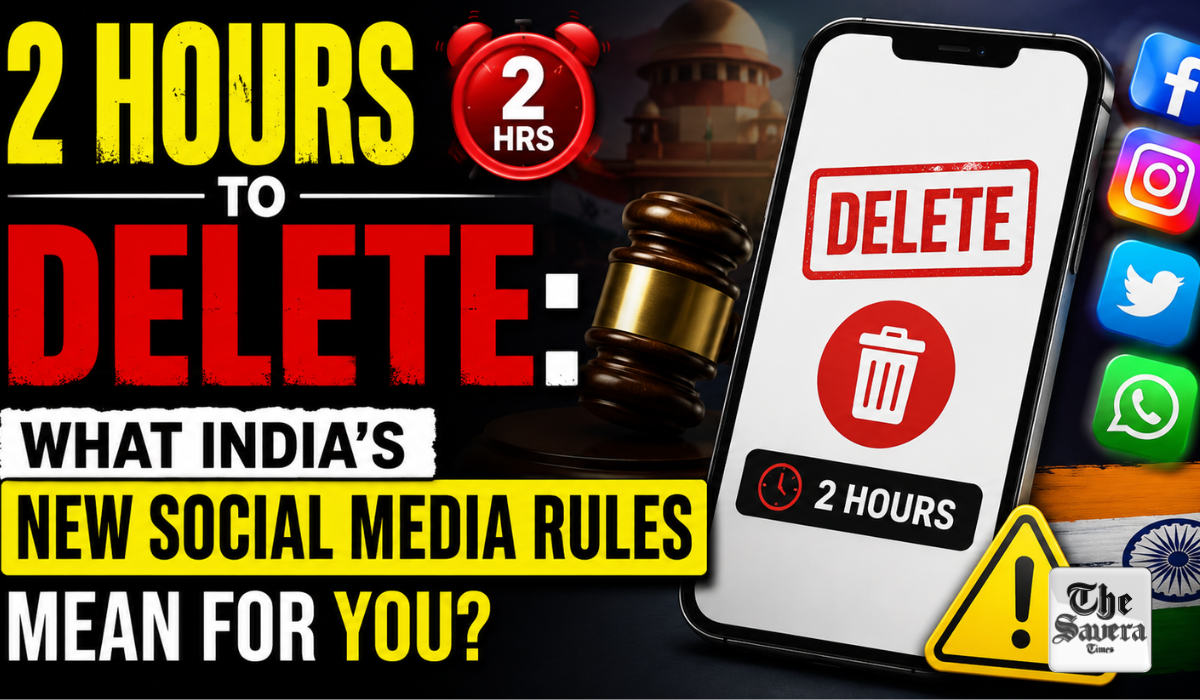
Imagine opening Instagram and finding a fake video of yourself going viral. Or a morphed photo spreading across social media within minutes. Until now, platforms had almost an entire day to respond. But now that has changed.
The Indian government has dramatically tightened its social media rules. Platforms like Instagram, Facebook, X and YouTube must now remove certain categories of harmful content within just two hours of receiving a valid complaint or legal direction. From deepfakes and impersonation to non-consensual intimate images, the new rules aim to stop harmful content before it goes viral. But how will these rules work, and what do they mean for millions of internet users? Let’s break it down.
What Has Changed?
The Ministry of Electronics and Information Technology (MeitY) has reduced the time available to social media companies to remove certain categories of harmful content after they receive a valid complaint or legal notice.
Earlier, platforms had up to 24 hours to remove sensitive content such as non-consensual intimate images or deepfake impersonation. Under the new rules, that time has been reduced to 2 hours.
Similarly, if the government or a court orders the removal of unlawful content, companies earlier had 36 hours to comply. Now, they must remove such content within 3 hours. The revised timelines are among the strictest content moderation requirements globally.
Which Content Must Be Removed Quickly?
The new rules mainly focus on content that can cause immediate harm.
This includes:
The idea is to stop harmful content before it spreads widely across social media and causes irreversible damage.
New Rules for AI-Generated Content
Another major change relates to Artificial Intelligence.
If a photo, video or audio has been created or significantly modified using AI in a way that could appear real, it must now carry a clear label or disclaimer informing users that it is AI-generated or synthetically created.
The government has made it mandatory for platforms to ensure that such content is properly identified. If creators fail to disclose AI-generated material, platforms may detect, label or remove it under their compliance mechanisms. Everyday edits such as brightness adjustments, filters or basic image enhancement are generally not the focus of these rules.
Why Is the Government Doing This?
The government says the changes are aimed at protecting users from rapidly spreading harmful content, especially deepfakes, online fraud, impersonation and non-consensual intimate images.
With AI tools becoming more advanced, fake videos and voice clones can spread within minutes and often reach millions before platforms take action. By reducing the response time, the government hopes to minimise the damage caused by such content. Officials have also argued that shorter timelines are necessary because viral content can create public disorder or cause serious personal harm within a few hours.
What Happens If Platforms Fail to Comply?
The new rules increase the legal responsibility of social media intermediaries.
If platforms repeatedly fail to comply with mandatory takedown timelines, they could risk losing their safe harbour protection under Section 79 of the Information Technology Act.
Safe harbour protects platforms from being held legally responsible for content posted by users, provided they follow the due diligence requirements laid down under the law. Losing this protection could expose companies to greater legal liability for user-generated content.
What Does This Mean for Users?
For ordinary users, harmful content such as deepfakes, revenge pornography and fake impersonation videos could disappear much faster than before.
Victims of online abuse may receive quicker relief, reducing the chances of damaging content going viral.
However, there is another side to the debate. Because companies now have very little time to act, experts believe platforms may increasingly depend on automated AI systems to detect and remove content.
This could sometimes lead to mistakes, where satire, parody, journalism or legitimate public-interest posts are removed temporarily until reviewed. Legal experts have also questioned whether the short deadlines leave enough time for careful assessment of every complaint.
The Bottom Line
India has introduced one of its toughest online content moderation frameworks yet. The new rules aim to make the internet safer by ensuring faster removal of harmful content and greater transparency around AI-generated media.
At the same time, they also place much greater responsibility on social media companies to respond quickly and accurately. As AI-generated content continues to grow, these rules are likely to play a major role in shaping how platforms moderate content and how users experience social media in the coming years.
Imagine opening WhatsApp on your phone, but the SIM card linked to your account is not inside the...

Delhi’s air pollution is once again raising health concerns, with the Air Quality Index (AQI) entering the ‘poor’...
Ladakh is seeing two changes at once: a new district has been announced, and the Centre has proposed...

What if a decision taken in Washington could influence India’s oil bills, export earnings and trade relations with...

What happens when the world’s richest business leaders clash over one of the world’s biggest internet markets? A...

Pakistan is heading into its wheat-growing season with a serious water problem. The country is facing a projected...
Aries: The day will be auspicious...