Last Updated: October 21, 2026
Last Updated: October 21, 2026





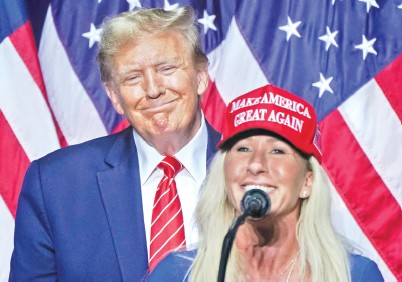
Marjorie Taylor Greene, once one of the most outspoken supporters of former US President Donald Trump, has announced her resignation from Congress, effective January 5, 2026. The Georgia Republican, celebrated in earlier years for her staunch defense of Trump, has become the target of his harshest public criticisms. Trump has called her a “traitor,” a “disgrace,” and a “ranting lunatic,” illustrating just how dramatically their political alliance has eroded.
Greene’s political journey began far from Washington. In 2017, she emerged in conservative activism circles through the website American Truth Seekers, known for promoting conspiracy-driven narratives. She later became involved with the Family America Project, a grassroots network that bolstered her credibility among anti-establishment conservatives. These early roles positioned Greene as a polarizing figure willing to challenge federal authority, laying the groundwork for her electoral ambitions.
When selecting a district for her congressional bid, Greene chose Georgia’s 14th, a heavily Republican area where the primary was the decisive contest. Her campaign presented her as an unapologetic pro-Trump alternative to traditional Republicans. She aggressively criticized liberalism and antifa while embracing provocative imagery, such as a campaign ad featuring her with an assault rifle. Trump initially withheld endorsement but eventually supported her in the GOP run-off, helping her secure both the nomination and the general election.
Upon arriving in Congress in January 2021, Greene quickly cemented her reputation as a polarizing figure. She publicly questioned the legitimacy of Joe Biden’s victory, wore a mask declaring “Trump won,” and faced scrutiny for past social media posts promoting QAnon conspiracies, doubting mass shootings, and suggesting sinister global plots. Her controversial statements led the House to strip her of committee assignments, yet these actions only strengthened her appeal among hardline Republican voters.
Greene’s relationship with Trump, once loyal and steadfast, began to unravel in 2025 over the release of Jeffrey Epstein files. Supporting bipartisan efforts to make the documents public, Greene prioritized transparency about networks surrounding Epstein, a convicted sex offender. Trump opposed this move, branding her disloyal and accusing her of drifting leftward. Public exchanges between them turned personal, with Greene insisting she acted out of concern for trafficking victims and criticizing Trump for his priorities.
Policy disagreements widened the rift. Greene publicly condemned Israel’s actions in Gaza, questioned US support for Ukraine, and opposed large financial interventions abroad. She also advocated eliminating the H1B visa program, a proposal Trump did not back. These stances set her apart not just from Trump but also from mainstream Republicans, highlighting her willingness to challenge party orthodoxy.
In her resignation statement, Greene framed her departure as a stand against a political system she views as increasingly disconnected from voters. She expressed frustration at divisive primaries, congressional inefficiency, and the failure of elected officials to address rising costs, household debt, and housing crises. She emphasized that she would not remain in a body she felt ignored the needs of ordinary Americans.
Greene’s exit marks the end of a turbulent chapter in US politics, reflecting both the volatility of Trump-era alliances and the complexities of a figure who navigated fame, controversy, and ideological battles. Her tenure illustrates the fine line between staunch loyalty and principled dissent, and her departure leaves a vacuum in the faction of the Republican Party she once helped energize.
Protests in Jakarta, Yogyakarta and Bandung brought students onto the streets over rising costs, forest fires and civil...
Organisations linked to Neville Roy Singham are under US congressional scrutiny over funding. Their coverage of protests in...

US President Donald Trump says Washington and New Delhi are close to a trade agreement that will differ...
Iran has ruled out transferring its enriched uranium stockpile outside the country, with security official Mohsen Rezaei reiterating...

Donald Trump has urged Volodymyr Zelensky to pursue a peace deal with Russia, warning that Ukraine could face...
Pakistan, battling insurgencies at home and tensions along multiple borders, is too overstretched to offer meaningful military support...
Aries: The day will be auspicious...