Last Updated: October 24, 2026
Last Updated: October 24, 2026





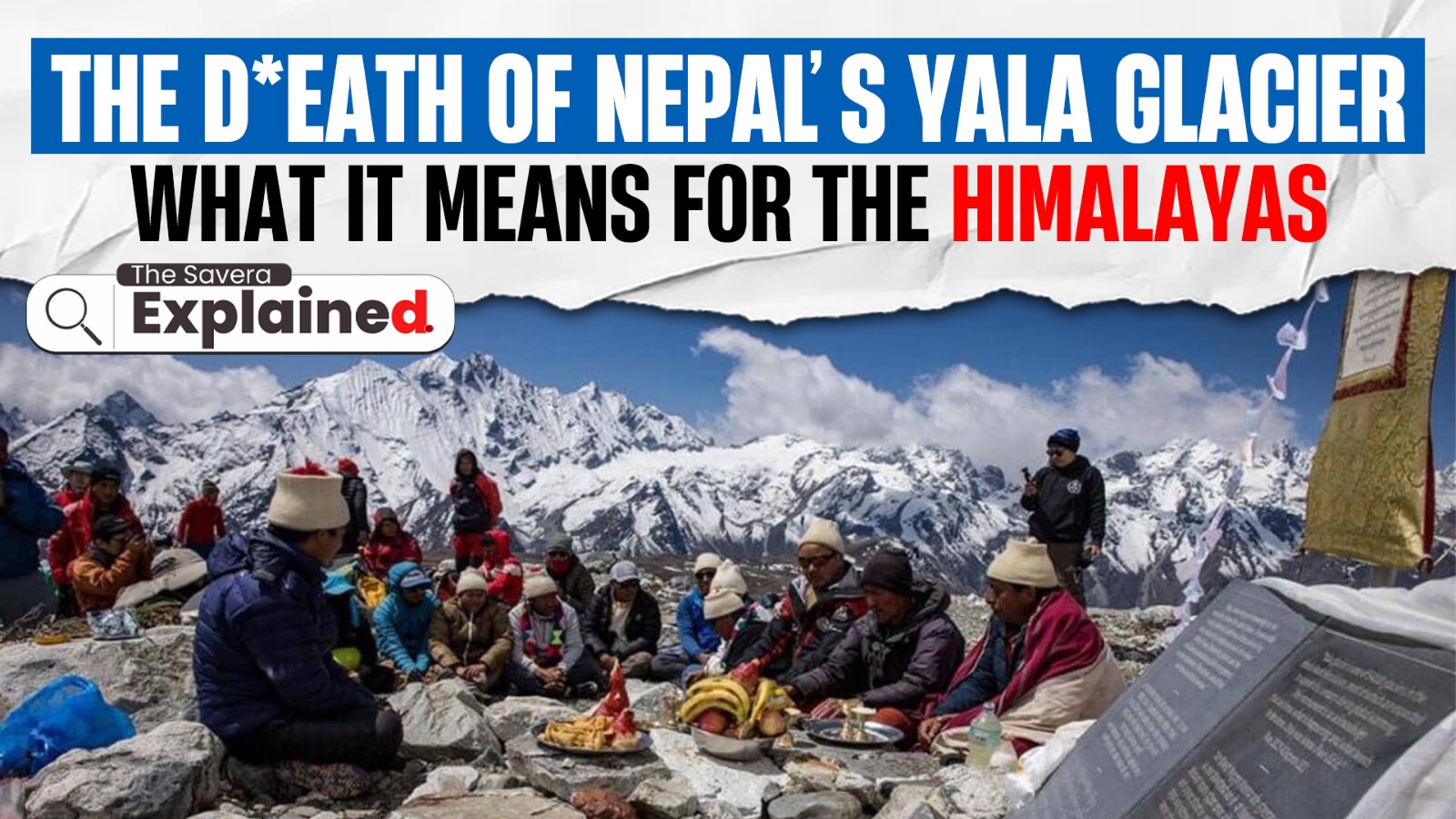
The funeral of Nepal’s Yala Glacier on May 12, 2025, was not just a ceremonial event but a stark reminder of how rapidly climate change is reshaping the world’s high mountains. Scientists, Buddhist monks, and local communities gathered in Langtang, Nepal, to mourn the glacier’s death — making it the first in Nepal and the third worldwide to be officially declared “dead.”
Why Yala Matters
Located in Langtang National Park, Yala has been an important site for cryosphere research and training. Over the past five decades, it has shrunk by 66% and retreated 784 metres. For more than 100 glaciologists, it served as a vital training ground, offering crucial data on melt rates, snow cover, and long-term climate change. Though Yala’s contribution to water flow downstream was limited compared to larger glaciers, its scientific value was immense.
“This is an important glacier because it has been used as a training site… The field data highlights in unprecedented detail how climate change is affecting glaciers,” said Sher Muhammad, remote sensing specialist at ICIMOD (International Centre for Integrated Mountain Development).
A Glacier Funeral
The farewell ceremony for Yala resembled funerals held earlier for glaciers in Iceland (OK Glacier, 2019), Mexico (Ayoloco, 2021), and Switzerland (Pizol, 2019; Basodino, 2021). At Yala, two granite plaques were unveiled, inscribed with reflections by writers Manjushree Thapa and Andri Snaer Magnason.
Magnason’s plaque read:
“Yala glacier is one of 54,000 glaciers in the Hindu Kush Himalayas, most of which are expected to vanish this century due to global warming. This monument is to acknowledge that we know what is happening and what needs to be done. Only you know if we did it.”
Thapa’s poetic message urged people to “dream of a glacier and the civilisations downstream… Entire ecosystems: our own sustenance.”
The ritual also included a Buddhist prayer service, underscoring how deeply glaciers are tied to local spirituality and culture in the Himalayas.
The Bigger Picture: Glaciers in Retreat
Yala’s death is symbolic of a much larger crisis. The Hindu Kush Himalaya (HKH) region, stretching 3,500 km across eight countries, is home to more than 54,000 glaciers. According to ICIMOD, most are expected to vanish this century under current warming scenarios.
Since records began in 1975, Earth’s mountains have lost nearly nine trillion tonnes of ice — equivalent to a block of ice 2.7 metres thick spread across the landmass of India. The World Meteorological Organization (WMO) has called the 2022–24 period the largest three-year glacier mass loss on record.
In Nepal, Bhutan, India, and China, glacier retreat also increases the risk of glacial lake outburst floods (GLOFs). Bhutan’s Lemthang Glacier, for example, triggered devastating floods in 2015 when its glacial lake burst.
Water Security at Risk
For now, melting glaciers have temporarily increased water flow into Asia’s great river systems, including the Ganga, Brahmaputra, and Indus. But scientists warn that by the mid-21st century, this trend will reverse, leading to sharp declines in water availability.
A recent ICIMOD report found that snow persistence across the HKH hit a 23-year low in 2025, with a 23.6% drop compared to long-term averages. In the Ganga basin, snow cover was down 24.1% from normal levels, threatening flows to nearly two billion people who depend on the region’s rivers.
“I’ve trekked the Himalayas for decades. The pace and scale of deglaciation happening now is breathtaking,” said Shyam Saran, former Indian foreign secretary. “These challenges will dwarf the issues dividing us today if we don’t act together for our common future.”
A Warning to the World
The death of Yala is not just about one glacier. It is a warning sign for the world’s fragile mountain ecosystems and the billions who rely on them. While international declarations like the UN’s 2025 International Year of Glaciers’ Preservation highlight the urgency, scientists stress that without drastic cuts in global greenhouse gas emissions, glacier funerals like Yala’s will become tragically common.
Ladakh is seeing two changes at once: a new district has been announced, and the Centre has proposed...
What if a decision taken in Washington could influence India’s oil bills, export earnings and trade relations with...

What happens when the world’s richest business leaders clash over one of the world’s biggest internet markets? A...

Pakistan is heading into its wheat-growing season with a serious water problem. The country is facing a projected...
Imagine a foreign national standing among Indian citizens at a political protest, raising questions about the government or...

For thousands of Indian tech workers in the United States, a job offer is only the beginning of...

Aries: The day will be auspicious...