Last Updated: October 26, 2026
Last Updated: October 26, 2026





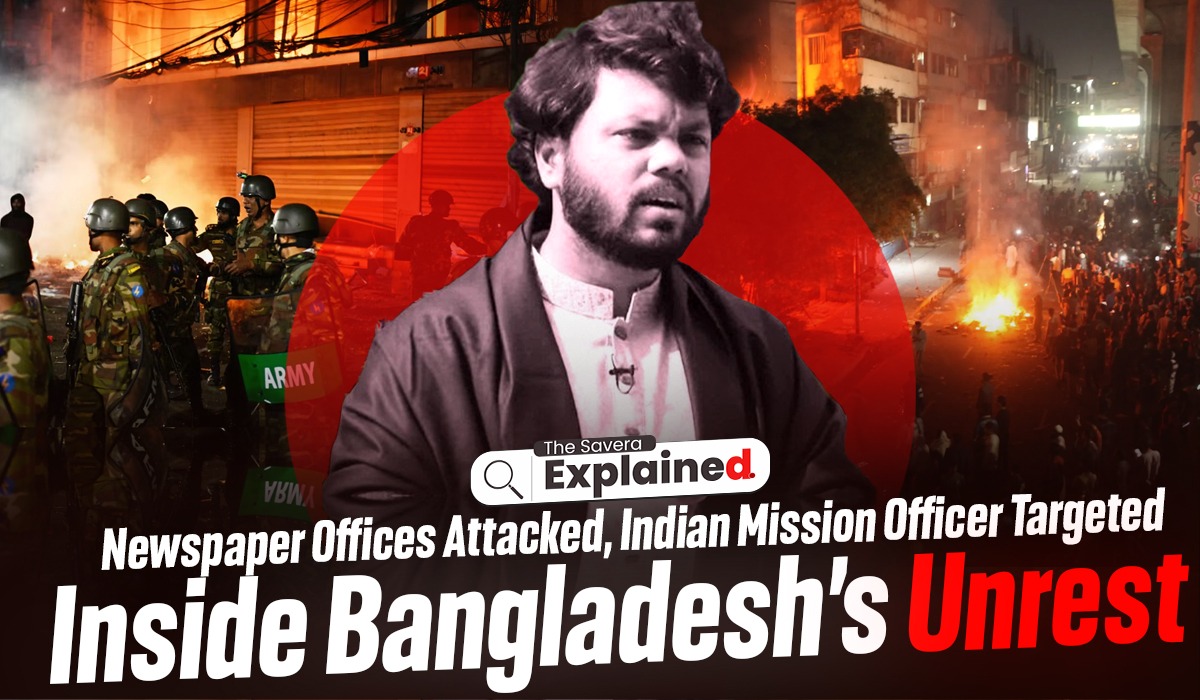
Bangladesh is witnessing one of its most turbulent moments in recent years, with widespread protests, violence and political tension following the killing of youth leader Sharif Osman Hadi in Dhaka. His death has triggered nationwide anger, pushing the country into a state of unrest just as it prepares for parliamentary elections next year.
Who was Sharif Osman Hadi?
Sharif Osman Hadi was the lead organiser and spokesperson of the Inqilab Manch, a youth-led political platform. He was known as a vocal critic of former Prime Minister Sheikh Hasina and of India’s influence in Bangladesh’s politics. Hadi was shot in broad daylight in Dhaka by motorcycle-borne assailants, an attack that shocked the nation.
After initially being treated in Dhaka, Hadi was flown to Singapore for advanced medical care. On Thursday night, Bangladesh’s interim government adviser Mohammad Yunus confirmed that Hadi had succumbed to his injuries. Yunus described his death as an “irreparable loss” to the country’s democratic space.
Protests erupt across Bangladesh
Hadi’s death sparked an immediate and emotional reaction. Tens of thousands of people poured onto the streets across the country, chanting his name and demanding justice. In Dhaka, the Shahbagh intersection became the centre of an all-night protest that began around 11 pm and continued into Friday morning.
Supporters of the Inqilab Manch, activists from July Moncho, and members of the National Citizen Party (NCP)—linked to last year’s student-led protests—joined the demonstrations. Protesters vowed to continue their movement until those responsible for Hadi’s killing were brought to justice.
Some protesters alleged that Hadi’s attackers had fled to India, a claim that the Bangladesh Police has firmly denied.
Media houses attacked and set on fire
As protests escalated, anger turned violent. Offices of leading newspapers Prothom Alo and The Daily Star in Dhaka’s Kawran Bazar area were vandalised and set on fire. Protesters armed with sticks and rods smashed windows, destroyed property and set furniture and documents ablaze.
Journalists inside the buildings were trapped as smoke filled the offices. Disturbing messages appeared on social media, including a post by The Daily Star reporter Zyma Islam, who said she was struggling to breathe due to heavy smoke.
After several hours, the Bangladesh Army and Fire Service evacuated around two dozen staff members. Fires were finally brought under control around 2 am. Army personnel have since been deployed outside The Daily Star building. Prothom Alo later announced that it could not publish its print edition and its online portal was temporarily unavailable due to the damage.
Indian interests targeted
Protests also took an anti-India turn. Demonstrators surrounded offices and residences linked to the Indian High Commission in Khulna and Chattogram. Stones and bricks were hurled at the Assistant Indian High Commissioner’s residence in Chattogram. Police used tear gas and baton charges to disperse the crowd, and several protesters were detained. Indian officials were reported to be safe.
The Indira Gandhi Cultural Centre in Dhaka was also vandalised and set on fire.
Attacks on landmarks and political figures
Historic and political sites were not spared. Dhanmondi 32, the former residence of Bangladesh’s founding father Sheikh Mujibur Rahman, was set ablaze again. Cultural institution Chhayanaut was vandalised, and Awami League offices in Rajshahi were demolished.
Homes of former ministers, including Mohibul Hasan Chowdhury Nowfel and Bir Bahadur Ushwe Sing, were torched in different parts of the country.
Lynching of a Hindu youth
Amid the chaos, a deeply disturbing incident took place in Mymensingh, where a Hindu youth, Dipu Chandra Das, was lynched by a mob after being accused of blasphemy. He was beaten to death, his body hung from a tree and set on fire. Police have sent the body for post-mortem, but no case has been filed so far.
A nation at a crossroads
The unrest comes at a sensitive time, just a day after the Election Commission announced the schedule for parliamentary elections. Interim adviser Mohammad Yunus has said he will step down after the polls.
With protests intensifying, institutions under attack and communal tensions rising, Bangladesh now stands at a critical crossroads, facing serious questions about law and order, political stability and the road ahead to elections.
Imagine opening WhatsApp on your phone, but the SIM card linked to your account is not inside the...

Delhi’s air pollution is once again raising health concerns, with the Air Quality Index (AQI) entering the ‘poor’...
Ladakh is seeing two changes at once: a new district has been announced, and the Centre has proposed...
What if a decision taken in Washington could influence India’s oil bills, export earnings and trade relations with...

What happens when the world’s richest business leaders clash over one of the world’s biggest internet markets? A...

Pakistan is heading into its wheat-growing season with a serious water problem. The country is facing a projected...

Aries: The day will be auspicious...