Last Updated: October 21, 2026
Last Updated: October 21, 2026





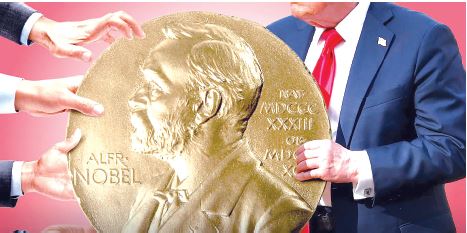
The 2025 Nobel Peace Prize has unfolded like a global political theatre. For weeks, the world speculated whether US President Donald Trump would win it, after his repeated claims that he was the greatest peacemaker in history and deserved several Nobel Prizes. His boasts sparked a flood of jokes and memes across social media. When the Norwegian Nobel Committee announced Venezuelan opposition leader Maria Corina Machado as the laureate, reactions worldwide ranged from relief to amusement, as if Trump had been dealt a symbolic defeat.
Machado’s name was unfamiliar to most, but within hours she became an international figure. Her first message as Nobel laureate, however, surprised many of her new admirers. She dedicated the award not only to the “suffering people of Venezuela” but also to President Trump, praising his “decisive support” for her cause—the ouster of Venezuelan President Nicolas Maduro and the restoration of democracy.
That cause has long been a priority for successive US administrations. Maduro, a socialist leader who succeeded Hugo Chavez in 2013, has ruled Venezuela through authoritarian means, crushing dissent and presiding over one of the worst economic collapses in modern history. Yet, history has shown that when Washington seeks to remove a dictator hostile to its interests, the outcome rarely leads to genuine democracy. The post-intervention realities in Iraq, Libya, and parts of the Arab Spring region underline that pattern.
Machado’s rise as a global symbol of democracy appears to mark the opening act in what analysts describe as a final phase of a coordinated push for regime change in Venezuela. Trump, in his trademark style, quickly claimed credit for her Nobel win. “The person who actually got the Nobel called me and said, ‘I’m accepting this in honour of you,’” he told reporters. Machado, in a subsequent Fox News interview, reiterated her admiration for Trump, declaring he deserved the award for “solving eight wars in a few months.”
In this elaborate geopolitical play, every actor seems to gain something. The Nobel Committee appears independent by denying Trump the prize, Machado receives international recognition and legitimacy, and Trump still claims moral ownership of the honour. For Washington’s strategic establishment—the so-called “Deep State”—the mission seems complete. Maduro and his allies in Moscow and Beijing remain the only losers.
Observers point to signs that the process was carefully orchestrated. The Nobel Committee’s phone call informing Machado of her award was filmed and shared publicly—an unprecedented move. The video, showing her overwhelmed and tearful reaction, quickly went viral, drawing millions of views and further humanising her image.
To understand this moment, it is essential to revisit Venezuela’s long and turbulent history. Hugo Chavez rose to power in 1998 with a promise of socialist reform and redistribution of wealth. Under him, and later under Maduro, Venezuela nationalised its oil and mining sectors, shutting out American companies that had profited for decades. The country, home to the world’s largest proven oil reserves and vast deposits of gold, iron ore, and diamonds, soon became a battleground of geopolitical interests.
Washington’s response went far beyond economic sanctions. The US accused Maduro’s government of drug trafficking and placed a $50 million bounty on his head. Over the years, Washington has supported opposition figures, financed at least one attempted coup, and allegedly backed assassination plots. Trump’s administration intensified this pressure. In recent months, his government deported over 200 Venezuelans, deployed warships near the country’s coast, and carried out an airstrike on a Venezuelan boat, claiming it carried narcotics. Behind the rhetoric of democracy lies the prize of 303 billion barrels of oil and 10,000 tonnes of gold.
Inside Venezuela, the situation remains dire. Maduro’s regime has crushed political opposition, suppressed protests with violence, and presided over hyperinflation and economic collapse. The GDP has plunged by 60 percent over the past decade, and more than 80 percent of the population lives in poverty. Inflation, which once exceeded 63,000 percent, now hovers around 200 percent. Corruption and crime are rampant, and millions have fled the country.
Machado, who turned 58 just days before her Nobel win, has been at the forefront of Venezuela’s opposition for years. Selected as the opposition’s presidential candidate last year, she was barred from contesting by the government. In July, she went into hiding, claiming threats to her life but refusing to leave the country. The Nobel citation praised her “struggle to achieve a just and peaceful transition from dictatorship to democracy.”
However, such transitions have rarely been peaceful. Machado’s movement has been marked by violent protests, arson, and street clashes. She has repeatedly called for foreign intervention, openly supporting Trump’s hardline policies toward Venezuela, Iran, and Gaza. Her courage and persistence are undeniable, but her alignment with Washington’s agenda raises questions about the long-term outcome for ordinary Venezuelans.
For Trump, the Nobel episode strengthens his political narrative. He casts himself as both a peacemaker and a decisive global player. For the US Deep State, the potential ousting of Maduro promises renewed access to Venezuela’s vast resources and a strategic foothold in Latin America. If Machado comes to power, Washington could also use Venezuela as leverage against Brazil’s current government, which Trump has openly criticised.
The operation mirrors earlier interventions. In Bangladesh last year, and in Nepal more recently, Washington-backed “democratic movements” followed a familiar pattern—domestic unrest, external endorsement, and rapid regime change. Venezuela appears to be the next stage in this strategy.
The implications reach beyond Latin America. For countries like India, the episode serves as a reminder of how internal dissent can be exploited in the name of democracy and reform. While India’s scale and diversity make large-scale manipulation difficult, regional agitations and external narratives can still be amplified to serve broader geopolitical goals.
As for Trump, he hasn’t given up on his Nobel dream. He pointed out that the 2025 prize was awarded for work done in 2024, before his current term began, implying he still has a chance next year. If that happens, his acceptance speech, as he himself hinted, could be another global spectacle—one that might make the Nobel saga of 2025 look like just the opening act.
Protests in Jakarta, Yogyakarta and Bandung brought students onto the streets over rising costs, forest fires and civil...
Organisations linked to Neville Roy Singham are under US congressional scrutiny over funding. Their coverage of protests in...
US President Donald Trump says Washington and New Delhi are close to a trade agreement that will differ...
Iran has ruled out transferring its enriched uranium stockpile outside the country, with security official Mohsen Rezaei reiterating...
Donald Trump has urged Volodymyr Zelensky to pursue a peace deal with Russia, warning that Ukraine could face...
Pakistan, battling insurgencies at home and tensions along multiple borders, is too overstretched to offer meaningful military support...
Aries: The day will be auspicious...