Last Updated: October 26, 2026
Last Updated: October 26, 2026





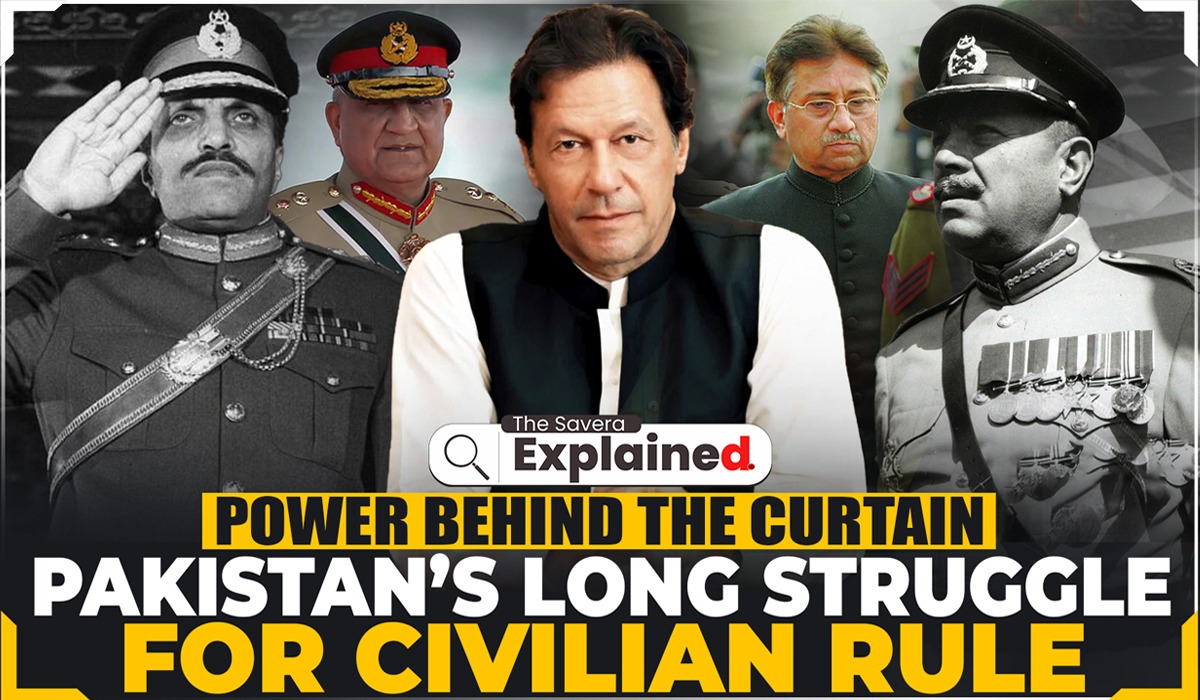
Pakistan: Pakistan’s journey since its creation in 1947 has been one of high hopes repeatedly colliding with political instability. Born amid the chaos of partition, the new country faced massive refugee inflows, fragile institutions, economic pressures and internal tensions—especially between its western and eastern wings.
Throughout these crises, one institution remained cohesive and powerful: the Pakistan Army. Whenever elected governments faltered, the military intervened, sometimes through direct coups and sometimes through indirect control.
This explainer traces how Pakistan’s three major coups—and later the era of “hybrid rule”—reshaped the country’s political system.
The First Coup: Ayub Khan’s Iron Grip (1958)
Only 11 years after independence, Pakistan’s parliamentary experiment was unraveling. Prime ministers changed frequently and the 1956 Constitution failed to stabilise the system. On October 7, 1958, President Iskander Mirza declared martial law and appointed Army Chief General Ayub Khan to govern. Weeks later, Ayub removed Mirza and consolidated full authority.
Ayub replaced the parliamentary structure with a strong presidential system under the 1962 Constitution. His “Basic Democracies” scheme created local councils whose members indirectly elected the president—centralising power and weakening political parties.
His decade in power brought economic growth, industrialisation, and close U.S. support during the Cold War. But political freedoms shrank, the press was censored, and courts were undermined. Most importantly, East Pakistan felt neglected and marginalised, setting the stage for the 1971 breakup. Mass protests forced Ayub to resign in 1969, but the military’s primacy in politics had become entrenched.
The Second Coup: Zia’s Islamisation and Control (1977)
After East Pakistan’s secession in 1971, Zulfikar Ali Bhutto rebuilt civilian rule and oversaw the 1973 Constitution. However, disputed 1977 elections triggered unrest. On July 5, 1977, Army Chief General Zia-ul-Haq ousted Bhutto, imposed martial law, and suspended the constitution.
Zia ruled for 11 years, shaping Pakistan’s politics, laws, and identity. His Islamisation program introduced the Hudood Ordinances and other laws that imposed severe punishments, disproportionately affecting women and minorities.
He weakened political parties through non-party elections in 1985, intentionally dividing civilian leadership. Bhutto’s controversial execution in 1979 left lasting bitterness. Under Zia, the military expanded into business and economic sectors, while media censorship and public punishments became common. Zia died in a plane crash in 1988, but his political and legal legacy endured.
The Third Coup: Musharraf’s “Soft” Takeover (1999)
The 1990s saw unstable civilian governments led alternately by Benazir Bhutto and Nawaz Sharif, with recurring friction between elected leaders and the military. After the Kargil conflict with India, Sharif attempted to replace Army Chief General Pervez Musharraf. The military responded with a takeover on October 12, 1999.
Musharraf presented himself as a moderniser. He allowed private TV channels and introduced local governments, but constitutional amendments shifted power from parliament to the presidency. After 9/11, he became a key U.S. ally, gaining substantial military and economic support.
In 2007, facing growing opposition, Musharraf imposed emergency rule, sacked judges, and restricted the media. Mounting protests and impeachment threats forced him to resign in 2008.
Hybrid Rule Exposed: Imran Khan’s Rise and Fall (2018–2022)
Imran Khan’s 2018 electoral victory reflected public anger over corruption, though critics argued the environment favoured him.
His government launched welfare programs and reforms but struggled with inflation, debt, and political gridlock. By 2021, relations with military leadership deteriorated. On April 9, 2022, he was removed through Pakistan’s first successful no-confidence vote.
Shehbaz Sharif became prime minister, while Khan and his party faced arrests and legal challenges. In the contested 2024 elections, PTI-backed independents won the most seats but were sidelined by a rival coalition, deepening divisions.
The Debate Today
Pakistan has not passed a “27th Constitutional Amendment” formalising military supremacy, yet analysts argue that legal pressures, court decisions, and governance practices continue to weaken civilian authority. Elections occur regularly, but unelected institutions shape political outcomes—fueling the view that Pakistan operates under a “hybrid system.”
A Divided Legacy
Pakistan’s political history follows a repeating cycle: civilian weakness, military intervention, and weakened democratic institutions. Yet public participation, protest movements, and determined voters show that democratic aspiration remains strong. The challenge ahead is revitalising institutions and enabling genuine civilian rule before divisions deepen further.
Imagine opening WhatsApp on your phone, but the SIM card linked to your account is not inside the...

Delhi’s air pollution is once again raising health concerns, with the Air Quality Index (AQI) entering the ‘poor’...

Ladakh is seeing two changes at once: a new district has been announced, and the Centre has proposed...
What if a decision taken in Washington could influence India’s oil bills, export earnings and trade relations with...
What happens when the world’s richest business leaders clash over one of the world’s biggest internet markets? A...

Pakistan is heading into its wheat-growing season with a serious water problem. The country is facing a projected...
Aries: The day will be auspicious...