Last Updated: October 18, 2026
Last Updated: October 18, 2026





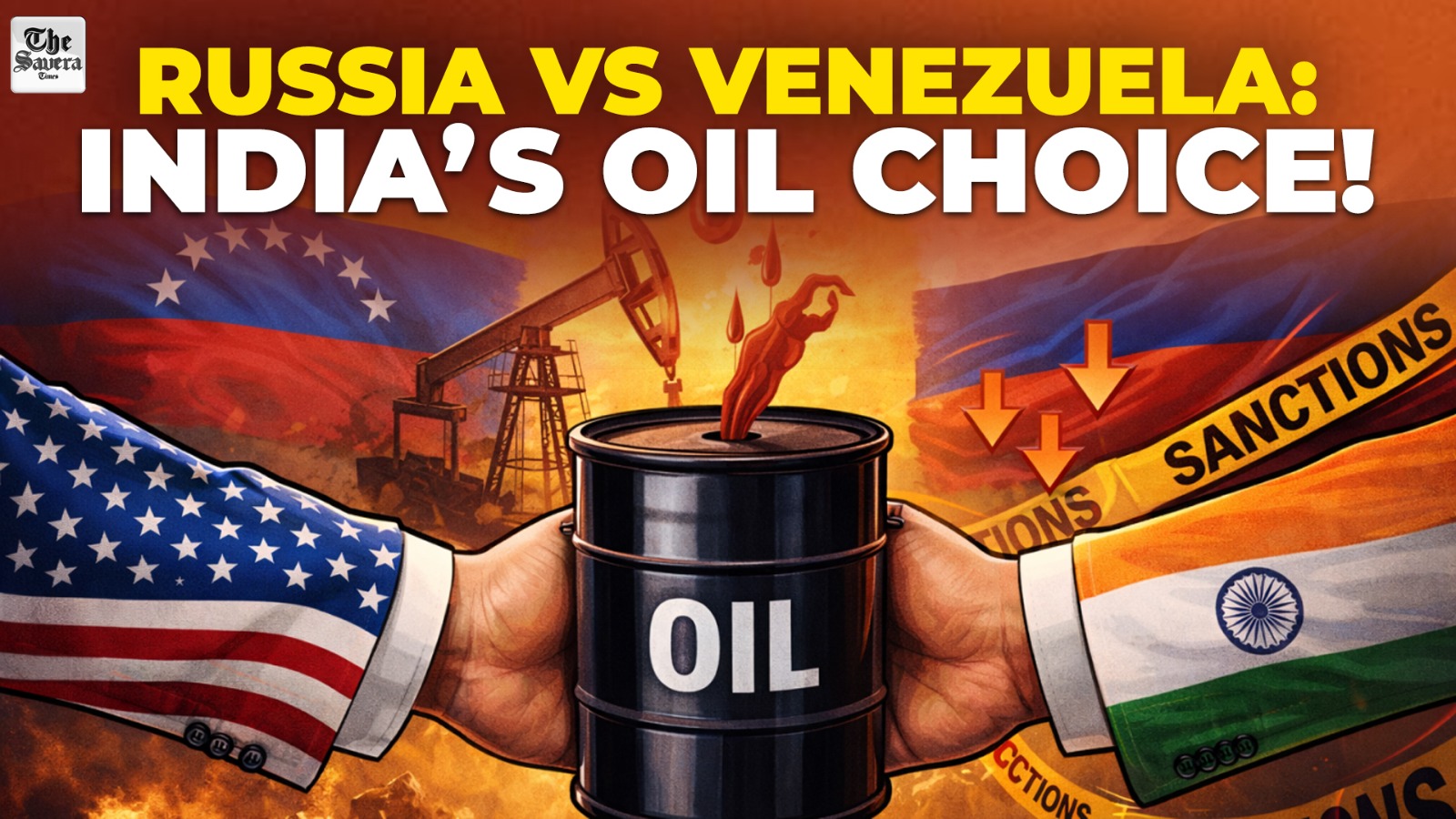
With global politics reshaping energy flows, this question is once again gaining urgency for the world’s third-largest oil importer.
India is watching developments in Venezuela closely after former US President Donald Trump claimed that Washington could remove Nicolás Maduro and take control of large volumes of sanctioned Venezuelan oil. At the same time, pressure is mounting on India’s biggest crude supplier — Russia — due to tougher US and European sanctions.
Together, these developments have reopened a critical debate for New Delhi: should India continue to rely on discounted Russian crude, or consider Venezuelan oil as an alternative?
India’s oil dependence at a glance
India consumes around 5 million barrels of oil per day, but produces only a fraction domestically. Nearly 90 per cent of its crude is imported, making energy security a constant priority.
Before the Ukraine war in 2022, India sourced most of its oil from Iraq, Saudi Arabia, the US and Russia. Since then, geopolitical shifts have dramatically altered this balance.
How Russia became India’s top oil supplier
After Western sanctions on Moscow, Russia offered crude at deep discounts to Asian buyers, and India seized the opportunity.
Between 2022 and 2025, India imported nearly $144 billion worth of Russian crude, becoming Russia’s second-largest buyer after China. Today, Russia supplies roughly 35 per cent of India’s oil needs, or about 2 million barrels per day.
The key advantage has been price. Russian crude has been sold at $10–15 per barrel below Brent, translating to a landed cost of roughly $50–54 per barrel for India. This helped manage inflation, stabilise fuel prices, and reduce the overall oil import bill.
Rising risks in Russian oil dependence
However, Russian oil now comes with political and economic risks.
The US and EU have steadily increased pressure on countries buying Russian energy. Trump previously imposed a 25 per cent levy on India for importing Russian crude and endorsed legislation allowing tariffs of up to 500 per cent on buyers of Russian oil.
These pressures have pushed India to diversify. According to Kpler data, Russian crude supplies to India fell to a three-year low of 1.2 million barrels per day in December 2025, and India’s monthly oil import bill declined sharply, reflecting both diversification and softer global prices.
India’s growing tilt towards US crude
As Russian volumes declined, US oil imports surged. Between April and November 2025, India’s imports from the US jumped nearly 92 per cent compared to the same period a year earlier. In November alone, US crude accounted for 13.2 per cent of total imports.
While this helps India rebalance geopolitical ties with Washington, US oil is priced closer to Brent, making it more expensive than Russian crude.
Venezuela: a former partner, now a marginal supplier
Despite holding the world’s largest proven oil reserves, Venezuela plays a small role in India’s energy basket.
In 2024, India imported only 22 million barrels of Venezuelan crude, about 1.5 per cent of total imports, worth roughly $1 billion. This is a steep fall from the mid-2010s, when Venezuela supplied around 12 per cent of India’s oil and bilateral trade peaked at $13 billion in 2013. US sanctions, payment challenges, and declining production caused this collapse.
Trump’s Venezuela claim and fresh uncertainty
Trump’s recent claim that Venezuela could “turn over” 30–50 million barrels of sanctioned oil, with proceeds controlled by the US, has added fresh uncertainty.
It is unclear who would be allowed to sell Venezuelan oil, how pricing would be decided, and whether India would get access. Former Ambassador Deepak Bhojwani has cautioned that US companies may be prioritised to recover losses before others benefit.
Russia vs Venezuela: the price equation
For India, cost remains decisive.
Venezuelan oil is $7–10 per barrel more expensive, and if linked to Brent, costs could rise further.
Strategic ties and final take
India shares a long-standing partnership with Russia across defence, energy and diplomacy. Ties with Venezuela have weakened due to sanctions and instability. Any revival depends heavily on US policy, making Venezuelan oil politically uncertain.
For now, Russian oil remains the safer and cheaper choice. Venezuelan crude could emerge as a medium- to long-term diversification option, but until production stabilises and pricing is competitive, India’s strategy is clear: reduce overdependence, diversify cautiously, and keep Russian crude as the backbone of energy security.
What if a decision taken in Washington could influence India’s oil bills, export earnings and trade relations with...
What happens when the world’s richest business leaders clash over one of the world’s biggest internet markets? A...

Pakistan is heading into its wheat-growing season with a serious water problem. The country is facing a projected...
Imagine a foreign national standing among Indian citizens at a political protest, raising questions about the government or...

For thousands of Indian tech workers in the United States, a job offer is only the beginning of...

Three years ago, on October 7, 2023, Israel woke up to one of the deadliest attacks in its...