Last Updated: October 18, 2026
Last Updated: October 18, 2026





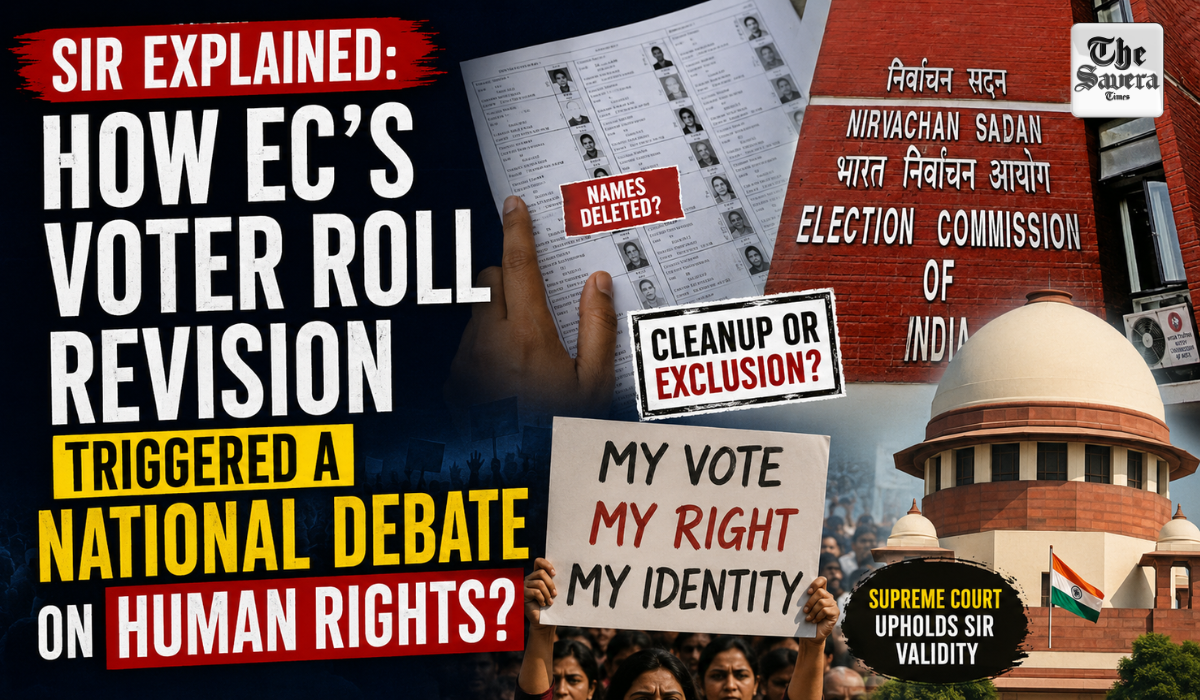
In one of the most politically explosive election exercises in recent years, the Election Commission of India’s (ECI) Special Intensive Revision (SIR) of electoral rolls triggered protests, legal battles, and fears of voter disenfranchisement across several states. Though the Supreme Court has now upheld the exercise as constitutionally valid, the controversy surrounding it continues to dominate political debate.
At the centre of the storm was a critical question: Was the ECI simply cleaning up voter lists, or were genuine citizens being unfairly forced to prove their identity and citizenship?
What Is SIR?
The Special Intensive Revision, or SIR, is a large-scale verification drive carried out by the ECI to update electoral rolls. According to the Commission, the exercise aimed to remove duplicate, fake, deceased, or ineligible voters and ensure clean voter lists before key assembly elections.
The drive began in Bihar and was later expanded to 12 states and Union Territories, including Uttar Pradesh, West Bengal, and Tamil Nadu.
Why Did It Spark Controversy?
The biggest flashpoint was the demand for documents.
The ECI required many voters, especially those added to electoral rolls after 2002–2003, to provide documentary proof linking themselves to individuals listed in older “legacy rolls” from those years. Critics argued that this effectively forced citizens to prove their citizenship before an election body.
Opposition parties and activists labelled the process a “de facto NRC,” comparing it to the National Register of Citizens exercise. They argued that citizenship verification falls under the Ministry of Home Affairs, not the Election Commission.
The controversy intensified as large numbers of names were deleted or placed “under adjudication.” Reports suggested that over 2 crore names were removed in Uttar Pradesh, while nearly 90 lakh names in West Bengal were either deleted or marked for further scrutiny.
AI Flags And Political Allegations
Another major controversy was the ECI’s use of an AI-based system to identify “logical discrepancies” in voter data.
The software reportedly flagged spelling mismatches, unusual age gaps between parents and children, or inconsistencies between old and updated voter rolls. Opposition leaders alleged that the system disproportionately targeted Muslim-majority border districts in West Bengal, including Murshidabad and Malda.
West Bengal Chief Minister Mamata Banerjee and the Trinamool Congress strongly opposed the exercise, accusing the Centre and the ECI of attempting voter suppression before elections.
In Bihar too, the exercise faced backlash after reports emerged that thousands of voters had been wrongly grouped into single households or flagged due to clerical and technical errors.
Social Impact On Ground
The revision process created anxiety among vulnerable communities, especially migrant workers, tribal populations, daily wage earners, and rural citizens who often lacked access to old documents or digital systems.
In border regions of West Bengal, reports suggested fear and panic among residents worried about possible detention or deportation if their names were removed.
Booth Level Officers (BLOs), who conducted door-to-door verification, also complained about extreme workloads, lack of training, and delayed compensation during the rushed exercise.
The Supreme Court Verdict
Several petitions challenging the SIR were filed by civil society groups, including the Association for Democratic Reforms, along with opposition parties.
However, the Supreme Court upheld the constitutional validity of the exercise. The bench ruled that the ECI has the authority under Article 324 of the Constitution and the Representation of the People Act, 1950, to carry out such revisions.
The court said the exercise supports free and fair elections and does not violate constitutional principles. However, it clarified that deletion from voter rolls does not automatically cancel a person’s citizenship and that affected individuals can still seek legal remedies.
Even after the verdict, the political divide remains sharp. Supporters call SIR a necessary cleanup of voter lists, while critics argue it exposed millions of ordinary citizens to exclusion and bureaucratic hardship. As elections approach in several states, the debate over SIR has become a larger battle over democracy, identity, and voting rights in India.
What if a decision taken in Washington could influence India’s oil bills, export earnings and trade relations with...

What happens when the world’s richest business leaders clash over one of the world’s biggest internet markets? A...

Pakistan is heading into its wheat-growing season with a serious water problem. The country is facing a projected...

Imagine a foreign national standing among Indian citizens at a political protest, raising questions about the government or...
For thousands of Indian tech workers in the United States, a job offer is only the beginning of...

Three years ago, on October 7, 2023, Israel woke up to one of the deadliest attacks in its...