Last Updated: October 21, 2026
Last Updated: October 21, 2026





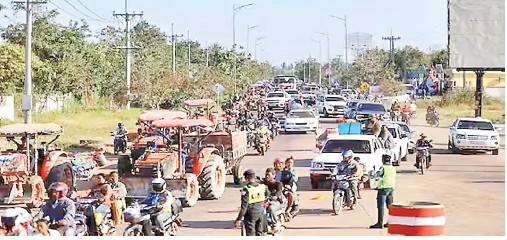
Six weeks after Thailand and Cambodia signed a ceasefire in the presence of US President Donald Trump, violence has erupted once again along their shared border, plunging the region back into conflict after a brief and fragile calm. The renewed hostilities began on Monday when Thailand launched airstrikes on Cambodian territory, saying the action was a direct response to an attack earlier that morning in which a Thai soldier was killed. The escalation marks a sharp reversal from the optimism that followed the October truce and has forced thousands of civilians to flee their homes.
According to the Thai military, the latest strikes targeted Cambodian military positions and infrastructure. Army spokesperson Major General Winthai Suvaree said that Thailand destroyed a cable car leading to the ancient Prasant ta Krabei temple and damaged concrete stairways along Hill 350. The Royal Thai Air Force reported that Cambodia had mobilised heavy weaponry, repositioned combat units and prepared fire-support elements, which Thailand described as steps that could threaten security along the border. Thailand’s prime minister, in a televised address, said the military would continue operations as needed to safeguard national sovereignty, adding that the country had no desire for conflict but would not tolerate violations of its territory.
Cambodia, however, rejected Thailand’s account and accused Bangkok of provoking the latest flare-up. The Cambodian Ministry of National Defence said Thai forces initiated the attacks on Monday morning and that Cambodia had refrained from striking back despite facing hostile actions for several days. Officials said three civilians were seriously injured in Oddar Meanchey province. Defence ministry spokesperson Maly Socheata further claimed that Thailand had used tanks, toxic gas and artillery fire against both Cambodian forces and civilian areas.
The former Cambodian prime minister Hun Sen also appealed for restraint, arguing that Thailand was attempting to provoke retaliation. He urged military commanders to ensure discipline among troops and avoid overstepping the boundaries already set by the country’s leadership. Despite these calls, reports suggested that the conflict had spread to civilian sites. According to a BBC report, Thai strikes hit a Cambodian casino complex, although Thailand insisted the site was being used as a drone command centre.
The renewed violence has sparked mass evacuations on both sides of the border, with residents fleeing to safer locations. Many had only recently returned home after the fierce fighting in July, which saw open clashes involving fighter jets, missile strikes and ground troops from both countries. That confrontation left 43 people dead and displaced hundreds of thousands. For residents like farmer Pannarat Woratham, who has now fled twice in a few months, the return of conflict came as a bitter shock. The earlier ceasefire led many to believe stability had finally returned.
The October ceasefire itself had been a high-profile diplomatic moment. The expanded agreement was signed in Kuala Lumpur with Trump and Malaysian Prime Minister Anwar Ibrahim present as witnesses. It came after months of heightened military tensions and was viewed as a significant breakthrough. However, the peace began to unravel quickly. Less than two weeks after signing, Thailand announced it was suspending the implementation of the agreement following a landmine explosion that severely injured a Thai soldier. Cambodia denied planting new mines, but the incident deepened mistrust.
Now, the collapse of the ceasefire and the resumption of conflict underscore the volatility of the Thailand-Cambodia border dispute. Despite repeated diplomatic efforts, both sides have struggled to establish a durable framework for peace and continue to accuse each other of violations. The renewed fighting indicates that the underlying issues remain unresolved and that the region risks becoming trapped in a cycle of fragile truces and sudden escalations.
Protests in Jakarta, Yogyakarta and Bandung brought students onto the streets over rising costs, forest fires and civil...
Organisations linked to Neville Roy Singham are under US congressional scrutiny over funding. Their coverage of protests in...

US President Donald Trump says Washington and New Delhi are close to a trade agreement that will differ...
Iran has ruled out transferring its enriched uranium stockpile outside the country, with security official Mohsen Rezaei reiterating...

Donald Trump has urged Volodymyr Zelensky to pursue a peace deal with Russia, warning that Ukraine could face...
Pakistan, battling insurgencies at home and tensions along multiple borders, is too overstretched to offer meaningful military support...
Aries: The day will be auspicious...