Last Updated: October 21, 2026
Last Updated: October 21, 2026





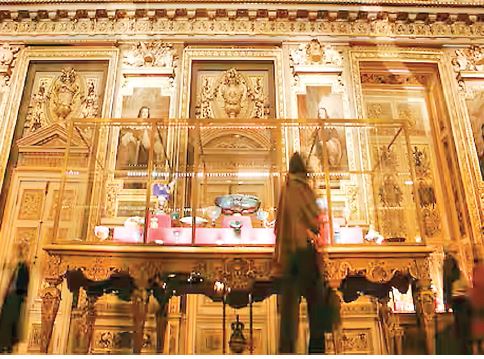
It was the kind of heist that felt straight out of a crime thriller. In broad daylight, a gang of four masked men broke into the world’s most famous museum — the Louvre in Paris — and vanished with royal jewels worth millions. The robbery, executed with precision and nerve, has already been dubbed the “heist of the century.” But what left investigators and historians equally stunned was what the thieves chose not to take.
Among the shattered glass and emptied display cases, one glittering masterpiece remained untouched — the 140-carat Regent Diamond, one of the purest and most storied gems in the world, and a treasure that once gleamed in the crowns of French monarchs. The fact that this particular diamond, mined centuries ago in India, was left behind has reignited interest in its turbulent past — a past steeped in conquest, superstition, and whispers of a curse.
The robbery that shook Paris
The break-in happened with almost military precision. Using a vehicle-mounted mechanical lift, the thieves gained access to the Louvre’s Galerie d’Apollon, home to France’s most valuable royal jewels. Within minutes, they cut through reinforced glass, overpowered two guards, and made off with priceless necklaces, brooches, and tiaras dating back to the 16th century — heirlooms of the Bourbon and Napoleonic dynasties. The entire operation took less than eight minutes.
By the time police arrived, the robbers had disappeared. French authorities have called it one of the most audacious museum thefts in modern history. Yet amid the chaos, one object in the gallery glimmered untouched under the spotlights: the Regent Diamond.
The gem that refused to leave
The Regent Diamond, weighing an impressive 140 carats, has a reputation that precedes it. Its story begins far from France, in the famed diamond mines of Golconda, in present-day Andhra Pradesh. The mines, known for producing some of the world’s most celebrated diamonds — including the Kohinoor and the Hope Diamond — were a key source of gems for Mughal rulers and European traders during the 17th and 18th centuries.
According to historical accounts, the Regent was discovered by an Indian slave around 1698. Legend says the man found the enormous uncut stone and tried to smuggle it out by hiding it in a self-inflicted wound on his leg. But his escape was short-lived — he was murdered by a British sea captain who stole the gem and later sold it to a merchant named Thomas Pitt, the then-Governor of Madras. Pitt had the diamond cut in London, a process that took two years, reducing its weight from 410 to 140 carats but enhancing its brilliance.
For years, it was known as the “Pitt Diamond.” Eventually, it was sold to the French Regent Philippe II, Duke of Orleans, for £135,000 — a vast fortune at the time — and renamed the Regent Diamond. It soon became a symbol of royal extravagance and political power.
A jewel of empires — and tragedies
The Regent adorned the crown of Louis XV, glittered on the hilt of Napoleon Bonaparte’s sword, and later rested in the coronation crowns of Charles X and Napoleon III. Each ruler treated the diamond as both an emblem of sovereignty and a charm of legitimacy. But over time, it earned a darker reputation.
The French Revolution in 1789 saw the diamond stolen from the Garde-Meuble, the royal treasury. It resurfaced years later, hidden in a Paris garret. Napoleon claimed it for himself, having it set in the pommel of his sword of state. When he was exiled to Elba, the sword — and the diamond — followed him into legend. After his defeat, the gem was reclaimed by the monarchy, surviving wars, invasions, and multiple regime changes.
The Regent has since remained on display in the Louvre, its facets reflecting not just light but centuries of history — of empire, betrayal, and blood. Some say it carries a curse. Every ruler who wore it, they claim, faced misfortune — death, exile, or downfall. From Louis XVI’s execution to Napoleon’s fall, the myth persists that the diamond brings ruin to those who seek to own it.
Why the thieves avoided it
So why did the modern-day robbers, who had access to the gallery, leave behind such a priceless artifact? Investigators have several theories. One is purely logistical — the Regent’s setting in a reinforced glass case with motion sensors made it almost impossible to remove quickly. The thieves were operating under a strict time limit and likely focused on smaller, more portable items.
But among art historians and the public, another idea has taken hold — superstition. “People who know the Regent’s story often speak of its curse,” said a senior curator at the Louvre. “It’s not inconceivable that even professional criminals might hesitate to touch it.”
A diamond steeped in history
Today, the Regent remains one of the Louvre’s most prized possessions, displayed alongside the French Crown Jewels in the Galerie d’Apollon. Its brilliance has endured revolutions, wars, and thefts. And while other treasures come and go, this diamond’s journey from India’s mines to the heart of France continues to fascinate.
As investigators chase leads across Europe, the “heist of the century” has brought new attention to the jewels of the past — and to one gem that defied fate yet again by staying exactly where it has always belonged. Whether by design or by destiny, the Regent Diamond remains the untouchable heart of the Louvre, carrying within it not just the glint of history, but the shadow of its own legend.
Protests in Jakarta, Yogyakarta and Bandung brought students onto the streets over rising costs, forest fires and civil...

Organisations linked to Neville Roy Singham are under US congressional scrutiny over funding. Their coverage of protests in...

US President Donald Trump says Washington and New Delhi are close to a trade agreement that will differ...

Iran has ruled out transferring its enriched uranium stockpile outside the country, with security official Mohsen Rezaei reiterating...

Donald Trump has urged Volodymyr Zelensky to pursue a peace deal with Russia, warning that Ukraine could face...

Pakistan, battling insurgencies at home and tensions along multiple borders, is too overstretched to offer meaningful military support...

Aries: The day will be auspicious...