Last Updated: October 21, 2026
Last Updated: October 21, 2026





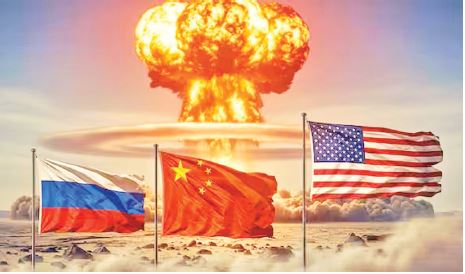
With a post on Truth Social, US President Donald Trump has announced the revival of nuclear weapons testing, overturning more than three decades of restraint. “I hated to do it, but had no choice! Russia is second, and China is a distant third, but will be even within five years,” he wrote, adding that he had instructed the Department of War to begin nuclear testing “on an equal basis.”
The United States last tested a nuclear weapon in 1992. That year, President George H. W. Bush imposed a moratorium on nuclear testing, marking the symbolic end of the Cold War’s most dangerous competition. Trump’s order represents a dramatic reversal of that long-standing policy, and signals a return to an era when nuclear might was a measure of global power.
A Look Back at the Nuclear Age
The nuclear era began in July 1945 when the United States detonated a 20-kilotonne atomic bomb in New Mexico. One month later, the US used nuclear weapons against Japan, dropping bombs on Hiroshima and Nagasaki. Those two attacks ended World War II but introduced the world to a new kind of terror.
The Soviet Union followed four years later, conducting its first nuclear test, known as “First Lightning,” in August 1949. In the decades that followed, nuclear testing became a grim marker of power. Britain conducted 45 tests, France carried out 210, and China 45.
The global backlash to testing led to the Comprehensive Nuclear Test-Ban Treaty (CTBT) in 1996, which prohibited all nuclear explosions for both military and civilian purposes. The United States signed the treaty but never ratified it, while countries such as India, Pakistan, and North Korea refused to sign. Since the CTBT’s adoption, only ten tests have been recorded — two by India and two by Pakistan in 1998, and six by North Korea between 2006 and 2017, according to United Nations data.
The Global Nuclear Arsenal
Trump’s directive has refocused attention on the size and strength of the world’s nuclear arsenals. According to the Arms Control Association’s January 2025 assessment, nine nuclear-armed states collectively possess about 12,400 nuclear warheads. Nearly 90 percent belong to the United States and Russia.
Russia leads the count with 5,580 nuclear warheads, including 1,200 retired weapons awaiting dismantlement. Of the remaining 4,380, some 1,549 are strategically deployed. The United States follows closely with 5,225 warheads, of which 3,748 are active and 1,477 are retired. China trails with about 600 nuclear warheads, all active.
Estimates from the Federation of American Scientists offer similar figures, noting that Russia maintains roughly 4,309 warheads in its stockpile, the US 3,700, and China 600 — though Beijing’s arsenal is expected to grow rapidly.
Russia’s Expanding Arsenal
Russia has intensified its nuclear activities in recent weeks. On October 21, Moscow tested the Burevestnik, a nuclear-powered cruise missile with what President Vladimir Putin described as “unlimited range.” Days later, it announced a successful test of the Poseidon — a nuclear-powered underwater drone designed to carry a warhead capable of generating radioactive tsunamis.
The tests underscore Russia’s growing emphasis on unconventional nuclear systems. Alongside the Poseidon and Burevestnik, Moscow has developed the Sarmat intercontinental ballistic missile (ICBM), the Avangard hypersonic glide vehicle, and the Kinzhal hypersonic missile. The revocation of Russia’s CTBT ratification in 2023 has further freed it to test these weapons without international constraints.
China’s Growing Capabilities
China, an ally of Russia, is also rapidly expanding its nuclear forces. Pentagon projections suggest Beijing could exceed 1,000 warheads by 2030. The Federation of American Scientists notes that China’s nuclear strategy relies heavily on land-based ICBMs, which it considers the most survivable part of its arsenal.
At this year’s Victory Day Parade, China displayed several nuclear-capable systems, including the DF-16 and DF-5C ICBMs. The DF-5C is believed to be capable of carrying multiple warheads with yields in the megaton range. China has also developed the JL-3 submarine-launched ballistic missile and an air-delivered system known as the JL-1, or JingLei-1, meaning “sudden thunder.”
America’s Nuclear Triad
The United States maintains what is known as the nuclear triad — a three-pronged deterrent comprising land-based missiles, submarine-launched missiles, and nuclear-capable bombers.
Its land-based component, the LGM-30G Minuteman III ICBM, has been on continuous alert since 1959. Each missile can travel more than 6,000 miles at speeds of up to 15,000 miles per hour.
At sea, America operates 14 Ohio-class ballistic missile submarines, each capable of carrying up to 20 submarine-launched ballistic missiles armed with multiple warheads. These vessels are central to the US deterrent strategy, designed for stealth and survivability.
In the air, the US deploys the B-52 Stratofortress and the B-2 Spirit stealth bomber. Both aircraft can deliver nuclear or precision conventional weapons and are key to ensuring the flexibility of the US deterrent posture.
Risks of Renewed Testing
Experts warn that Trump’s order could reignite a nuclear arms race reminiscent of the Cold War. Any US test would likely prompt reciprocal moves from Russia and China, deepening global instability. It would also erode decades of arms control progress and undermine efforts to prevent nuclear proliferation.
Beyond geopolitics, the environmental risks are significant. Even underground tests can release radioactive materials into the atmosphere or contaminate groundwater. Such consequences had driven earlier generations of leaders to halt testing in the first place.
Critics argue that Trump’s decision undermines the credibility of US leadership on arms control. The Atlantic, in an editorial, observed, “Resuming nuclear testing looks weak and petulant, not strong and confident. No American president should ever let the Kremlin get under his skin — especially not where nuclear weapons are concerned.”
As Washington prepares to restart testing, the world faces the prospect of a revived nuclear race — one that could redefine global security and resurrect the dangers the world thought it had left behind three decades ago.
Protests in Jakarta, Yogyakarta and Bandung brought students onto the streets over rising costs, forest fires and civil...
Organisations linked to Neville Roy Singham are under US congressional scrutiny over funding. Their coverage of protests in...

US President Donald Trump says Washington and New Delhi are close to a trade agreement that will differ...
Iran has ruled out transferring its enriched uranium stockpile outside the country, with security official Mohsen Rezaei reiterating...
Donald Trump has urged Volodymyr Zelensky to pursue a peace deal with Russia, warning that Ukraine could face...
Pakistan, battling insurgencies at home and tensions along multiple borders, is too overstretched to offer meaningful military support...
Aries: The day will be auspicious...