Last Updated: October 16, 2026
Last Updated: October 16, 2026





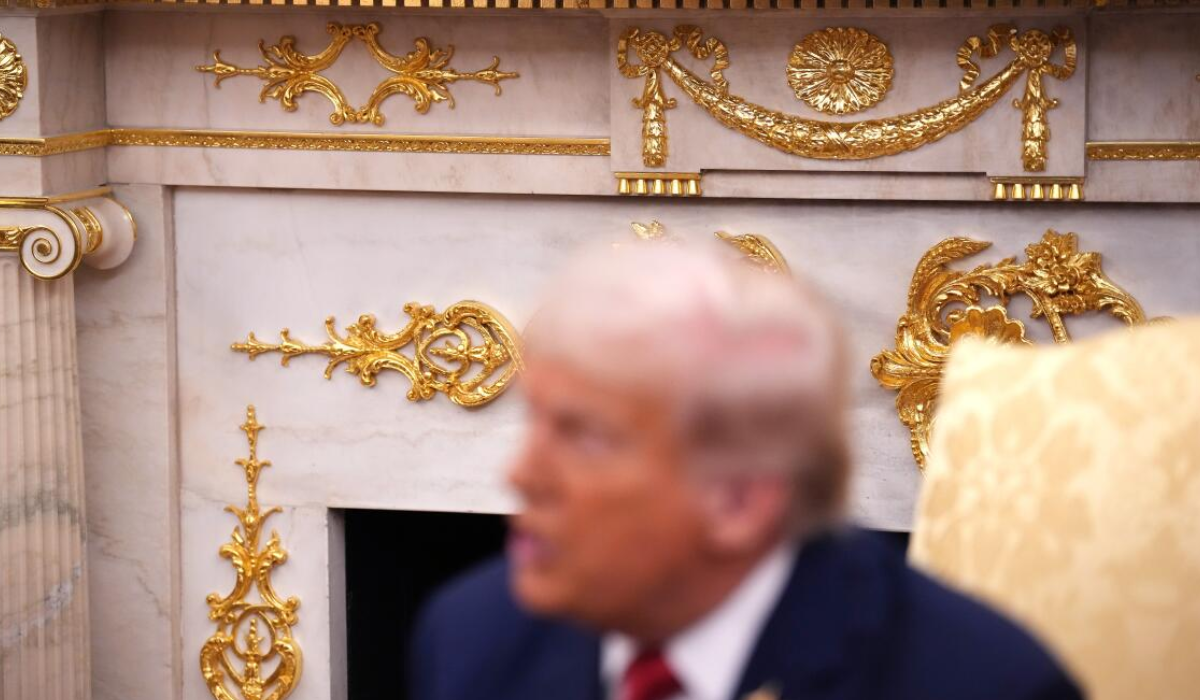
With oil prices surging past $4 a gallon amid the war in Iran, President Donald Trump turned his attention on Tuesday to a matter closer to home: the construction of a new White House ballroom. Flanked by reporters at the Resolute Desk, Trump brandished pages of handwritten notes in his signature Sharpie scrawl—this time over a federal judge’s ruling that construction must halt until congressional approval is obtained.
Even as wars rage abroad and the U.S. economy faces volatility, Trump remains preoccupied with shaping his physical legacy and the structural aesthetics of the capital.
Ballrooms, Libraries, and Legacy
Trump argued the new East Wing would house critical presidential facilities, including secure communications, bomb shelters, and major medical resources. He insisted the ballroom would be privately financed.
But the president’s attention is not limited to the White House. In the past week alone, he unveiled renderings for a waterfront presidential library in Miami, ordered repairs on the Lincoln Memorial’s reflecting pool, and publicly displayed ballroom plans in the press cabin of Air Force One.
“I’m so busy that I don’t have time to do this, I’m fighting wars and other things,” Trump told reporters. “But this is very important because this is going to be with us for a long time and it’s going to be, I think it’ll be the greatest ballroom anywhere in the world.”
Monumentalizing the Presidency
Historians and critics see Trump’s projects as more than mere architecture. For a president with no prior political experience and a combative relationship with Washington, reshaping civic spaces offers a chance to leave a lasting imprint, independent of controversies like impeachment and the January 6 events.
“You attempt to change its symbols. You monumentalize yourself. You impose a singular aesthetic vision,” said Greg Werkheiser of Cultural Heritage Partners, which filed a lawsuit challenging a White House repainting.
Trump’s initiatives range from cosmetic to transformative: gold decorations in the Oval Office, giant flagpoles, and plans for a Parisian-style arch near the National Mall.
“This is completely unprecedented,” said historian Benjamin Waterhouse. “A wholesale departure from almost every norm of presidential politics.”
Funding, Influence, and Controversy
Many of Trump’s projects rely on private donations from tech giants, foundations, and corporations—including Amazon, Google, Apple, Lockheed Martin, and Nvidia. While the White House claims no quid pro quo exists, critics argue the funding structure raises ethical concerns.
“It looks like a pay-to-play scheme and it smells like a pay-to-play scheme,” said Jon Golinger of Public Citizen.
Some projects still involve taxpayer money, such as $257 million for the Kennedy Center and $5.5 million for renaming Palm Beach International Airport after Trump.
Political and Historical Risks
While Trump sees legacy projects as transformational, historians warn they could backfire. Excessive focus on personal monuments may overshadow policy achievements and fuel perceptions of hubris.
“It does show a lack of confidence in how people will remember you,” said historian Jeremi Suri.
“The excess of it is what will define him—the hubris, the arrogance,” added David Axelrod, former adviser to President Obama.
Democrats are already considering how much of Trump’s architectural imprint could be reversed when they regain power.
“The physical question of what you do with Trump-demolished-and-rebuilt facilities is profound,” said Representative Jamie Raskin. “It is also a metaphor for what we’re going to do to rebuild America after this nightmare is over.”
Manjit Singh Bedi, 64, has been returned to the United States after being arrested in India. He faces...

A Houthi attack on the al-Maashiq Presidential Palace in Aden killed five people and injured 16, amid intensifying...

A shooting at Silver Rail Elementary School in Bend, Oregon, left three children and a teacher dead. The...

Prime Minister Narendra Modi will visit Canada on December 11-12, 2026, with both countries aiming to strengthen strategic...
US Vice President JD Vance has warned that anyone found selling access to the White House should face...
Washington: US President Donald Trump has claimed that drug cartels effectively control Mexico and warned that his administration...
Aries: The day will be auspicious...