Last Updated: October 21, 2026
Last Updated: October 21, 2026





The Banasura Chilappan is a mountain bird that prefers silence over spectacle. It moves through the dim undergrowth of Camel’s Hump in Wayanad, a fragile highland where shola forests cling to slopes repeatedly scarred by extreme weather. Sightings are uncommon. Its quiet presence has turned it into an emblem of Wayanad’s ecological unease and of the pressures building across the Western Ghats.
Camel’s Hump, the Chilappan’s refuge, now faces disruption from the proposed Wayanad tunnel road project, which would become one of India’s largest transportation tunnels. Supporters promise faster travel. Critics warn that tunnelling through an already unstable mountain system risks triggering new landslides, clearing forest tracts, and further weakening slopes that have failed under heavy rain in recent years. For many residents, the project signals not progress but the possibility of another disaster.
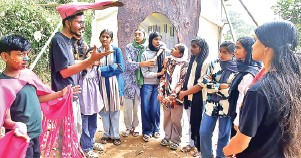
Against this backdrop, the first Wayanad Bird Festival, held from November 14 to 16 at Puliyarmala, took on a deeper meaning. Organised by the Hume Centre for Ecology and Wildlife Biology, it positioned birdwatching as a way to understand how climate and development choices are reshaping Wayanad. Its title, Heikki Banakku, combined Kattunayakan words for bird and festival, recognising the ecological knowledge embedded in indigenous traditions. For the Kattunayakans, bird calls and movements are indicators of seasonal shifts and forest health, insights that predate modern research.
Over three days, participants explored forest trails, guided to observe behaviour rather than collect sightings. A resting trogon, a drongo defending territory, a sudden hush before rainfall were treated as ecological signals. At the Hume Centre campus, exhibits explained identification skills, migration patterns, and threats faced by local species. Children listened to forest sounds through simple devices and learned how nests reflect habitat stability. A photography exhibition highlighted years of quiet documentation by local birders.
Academic sessions added context. Experts traced the evolution of ornithology, explained how acoustic technology and citizen reporting enrich research, and stressed the importance of monitoring environmental change in districts experiencing rapid ecological shifts. Cultural performances, including Bavul music and puppetry, broadened the festival’s emotional reach, turning conservation themes into stories accessible to all visitors.
Throughout discussions, the tunnel project resurfaced as a symbol of the tension between infrastructure and ecological security. Participants questioned whether Wayanad, already vulnerable to intense rainfall and soil movement, can absorb further disruption. Concerns also focused on unregulated tourism, changing wildlife patterns, and the need for stronger community stewardship.
Organisers hope to make Heikki Banakku an annual event linked to Salim Ali’s birth anniversary. If sustained, it could evolve into a public platform that captures Wayanad’s environmental shifts each year and strengthens the district’s collective understanding of its forests, species, and future.
Protests in Jakarta, Yogyakarta and Bandung brought students onto the streets over rising costs, forest fires and civil...
Organisations linked to Neville Roy Singham are under US congressional scrutiny over funding. Their coverage of protests in...

US President Donald Trump says Washington and New Delhi are close to a trade agreement that will differ...

Iran has ruled out transferring its enriched uranium stockpile outside the country, with security official Mohsen Rezaei reiterating...

Donald Trump has urged Volodymyr Zelensky to pursue a peace deal with Russia, warning that Ukraine could face...

Pakistan, battling insurgencies at home and tensions along multiple borders, is too overstretched to offer meaningful military support...

Aries: The day will be auspicious...