Last Updated: October 21, 2026
Last Updated: October 21, 2026





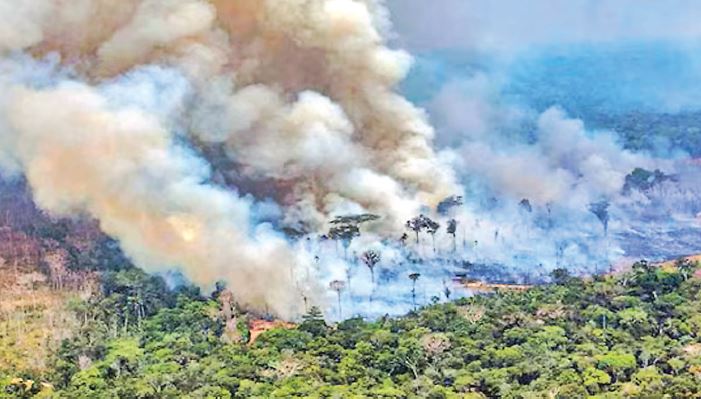
In the northern reaches of Brazil’s Amazon, fire is a familiar, almost trusted companion for ranchers and landowners. Known locally as “Joao Vermelho” or Red John, it clears pastures cheaply, enriching the soil for grazing, but leaves charred trees and blackened earth in its wake. In São Felix do Xingu, a municipality in the state of Pará, this practice has become so ingrained that abandoning it seems almost unthinkable.
“Fire is a cheap way to maintain pasture. Labour is expensive, pesticides are expensive. Here we don’t have any public funding,” said Antonio Carlos Batista, a rancher with 900 cattle. During the dry season, all it takes is a bit of gasoline and a match to ignite the flames. “When someone goes to light a fire, they say, ‘I’m going to hire the worker Red John!’” Batista added.
But Red John can be unc ontr ollable. An unprecedented drought in 2024, linked to climate change, fueled fires that blazed across nearly 18 million hectares of the Brazilian Amazon, destroying more tropical forest than grassland for the first time in recorded history.
São Felix do Xingu recorded over 7,000 fire outbreaks, the highest in Brazil. Most fires originated on cattle ranches, spreading through dry vegetation into forested areas. Environment Minister Marina Silva said, “The big challenge is deforestation caused by fires.” Experts note that addressing this issue requires more than firefighters—it demands stricter enforcement and, above all, a cultural shift.
Ranches such as Bom Jardim, home to 12,000 cattle and belonging to a former mayor repeatedly fined for environmental violations, suffered devastating losses. “Last year, the fires devoured everything,” said foreman Deforestation rose four per cent in the 12 months to July, reversing a 30-per cent decline achieved the previous year, a setback for President Luiz Inacio Lula da Silva, who has pledged to eradicate deforestation by 2030.
Gleyson Carvalho. “There was no food; the cattle lost weight. We had to fight hard to prevent any animals from dying.” Satellite data shows over two-thirds of the property burned, with smoke affecting nearby Kayapo Indigenous communities. Maria de Fatima Barbosa, a teacher in the village, described nights when “you couldn’t even breathe… everything smelled of smoke.”
While some small-scale farmers like Jose Juliao do Nascimento lament the destruction of their pastures and forest, others feel powerless in a system that favours large agribusiness. Dalmi Pereira, a small-scale farmer, said, “They call us criminals of the Amazon, responsible for the fires and deforestation, but no one helps us.” Meanwhile, large agricultural corporations like Agro SB, whose Lagoa do Triunfo complex spans thousands of hectares, have repeatedly faced fines but continue operations with minimal consequences.
Traditional practices also play a role. Local communities and small farmers have historically used fire for pasture management, yet the largest forest fires are now driven by expansive ranches and illegal mining, said Cristiane Mazzetti, forest coordinator for Greenpeace Brazil. Enforcement remains weak, with residents often alerted by WhatsApp if authorities approach, enabling them to hide equipment and evade penalties.
São Felix lacks firefighting infrastructure. Mayor Fabricio Batista highlighted that without proper documentation and federal support, residents struggle to protect their land. Regino Soares, head of a small livestock association, called for controlled burning methods, emphasizing firebreaks, timing, and communication with neighbors to prevent disasters.
The Amazon did see a reprieve this year, with fires at their lowest level since records began in 1998. According to Ane Alencar, scientific director of the Amazon Environmental Research Institute, rainfall distribution, increased oversight, and caution from farmers traumatized by last year’s fires contributed to the decline. Ibama president Rodrigo Agostinho noted that while authorities now deploy record numbers of firefighters and aircraft, monitoring remains challenging over such a vast territory.
Tracking and punishing those responsible for fires is complex. “You have to conduct an expert report, find someone responsible, and consult satellite images,” Agostinho explained, noting that artificial intelligence is aiding enforcement. Yet fines are often unpaid, and public policy alone cannot solve the crisis. Journalist João Moreira Salles, author of Arrabalde, emphasized that meaningful change requires local awareness and engagement. “What matters most is not that the world sees what’s being done, but that Brazil and Brazilians see it,” he said.
Despite recent improvements, the Amazon remains vulnerable. Deep-rooted cultural practices, economic pressures, and weak enforcement continue to challenge conservation efforts. For São Felix do Xingu and the broader Amazon, the question remains: how can tradition and development coexist with the urgent need to protect the planet’s largest tropical forest?
Protests in Jakarta, Yogyakarta and Bandung brought students onto the streets over rising costs, forest fires and civil...
Organisations linked to Neville Roy Singham are under US congressional scrutiny over funding. Their coverage of protests in...
US President Donald Trump says Washington and New Delhi are close to a trade agreement that will differ...

Iran has ruled out transferring its enriched uranium stockpile outside the country, with security official Mohsen Rezaei reiterating...

Donald Trump has urged Volodymyr Zelensky to pursue a peace deal with Russia, warning that Ukraine could face...

Pakistan, battling insurgencies at home and tensions along multiple borders, is too overstretched to offer meaningful military support...

Aries: The day will be auspicious...