Last Updated: October 21, 2026
Last Updated: October 21, 2026





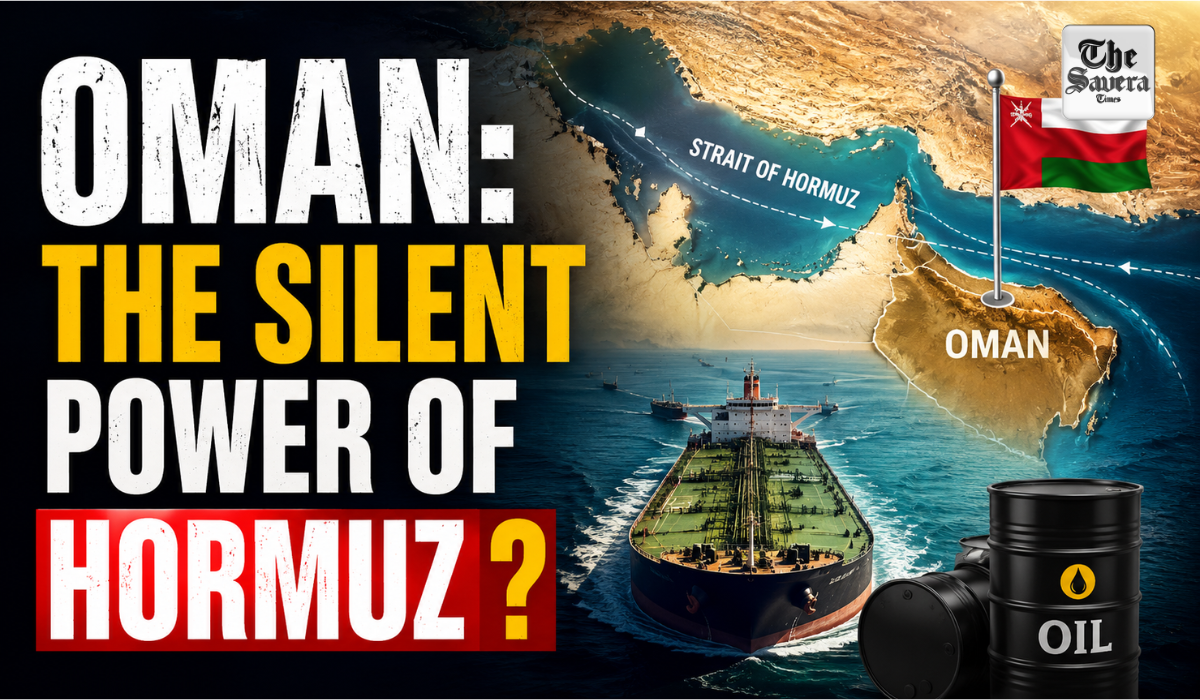
Imagine a narrow stretch of water that carries nearly one-fifth of the world’s oil supply every day.
Now imagine that a small country, with a population of just around five million people, controls some of the most important shipping routes in that waterway.
That country is Oman.
As tensions continue to rise in West Asia and the Strait of Hormuz remains at the centre of global attention, Oman has quietly emerged as one of the most important players in the region.
What is the Strait of Hormuz?
The Strait of Hormuz is a narrow water passage between Iran and Oman. It connects the Persian Gulf to the Gulf of Oman and the Arabian Sea.
This is the main route through which oil and natural gas from countries like Saudi Arabia, the UAE, Kuwait, Iraq and Qatar reach international markets.
Around 20 to 25 per cent of global seaborne oil exports move through this route, making it the world’s most important energy chokepoint.
Any disruption here can immediately affect oil prices, shipping costs and economies across the world.
Why is the Strait in the News?
The latest crisis began after military tensions between the United States, Israel and Iran escalated earlier this year.
Following military strikes and retaliatory actions, maritime traffic in the Strait of Hormuz came under pressure. Shipping companies became cautious, insurance costs increased sharply and global markets began closely tracking developments.
Countries that depend heavily on Gulf energy supplies, including India, China, Japan and South Korea, have been particularly concerned because any disruption can directly impact energy security and economic growth.
Where Does Oman Fit In?
Most people assume Iran is the key player because it has a long coastline along the Strait and significant military capabilities.
But geography tells a different story.
Although the Strait is about 39 kilometres wide at its narrowest point, large commercial ships cannot sail freely across the entire passage. They must use designated shipping lanes.
The deepest and safest channels used by international vessels pass close to Oman’s Musandam Peninsula, a strategically located exclave that overlooks the southern side of the Strait.
This gives Oman control over some of the most critical waters used by global shipping.
In simple terms, Iran may have the ability to disrupt maritime traffic, but Oman sits beside the routes that keep global trade moving.
The Legal and Diplomatic Advantage
Oman is also important because of its commitment to international maritime law.
As a signatory to the United Nations Convention on the Law of the Sea, Oman supports freedom of navigation through international waterways.
This position has helped it gain the trust of major powers, shipping companies and energy-importing nations.
At the same time, Oman has maintained friendly relations with both Iran and the United States for decades.
Unlike many countries in the region, Muscat has consistently avoided taking sides and instead focused on dialogue and diplomacy.
Why the World is Watching Oman
Recently, reports emerged about proposals linked to future management of shipping through the Strait of Hormuz, including discussions around transit fees and traffic regulation.
The issue drew global attention because any restrictions or additional costs could affect international trade and energy markets.
The United States strongly opposed any move that could limit free navigation through the Strait, while Oman carefully maintained its neutral position and avoided endorsing controversial proposals.
This highlights the delicate balancing act Muscat faces between its neighbour Iran and its long-standing partner, the United States.
The Strait of Hormuz remains one of the world’s most important waterways, carrying a significant share of global energy supplies.
And while major powers often dominate the headlines, Oman has emerged as a crucial player because of its unique geography, legal position and diplomatic influence.
It may not have the largest military or the loudest voice in international politics, but Oman occupies a strategic position that gives it enormous importance.
In today’s Hormuz crisis, Oman is far more than a bystander. It is a key stabilising force whose decisions and diplomacy could help determine whether one of the world’s most critical trade routes remains open, secure and accessible to the world.
Ladakh is seeing two changes at once: a new district has been announced, and the Centre has proposed...

What if a decision taken in Washington could influence India’s oil bills, export earnings and trade relations with...

What happens when the world’s richest business leaders clash over one of the world’s biggest internet markets? A...

Pakistan is heading into its wheat-growing season with a serious water problem. The country is facing a projected...
Imagine a foreign national standing among Indian citizens at a political protest, raising questions about the government or...

For thousands of Indian tech workers in the United States, a job offer is only the beginning of...

Aries: The day will be auspicious...