Last Updated: October 21, 2026
Last Updated: October 21, 2026





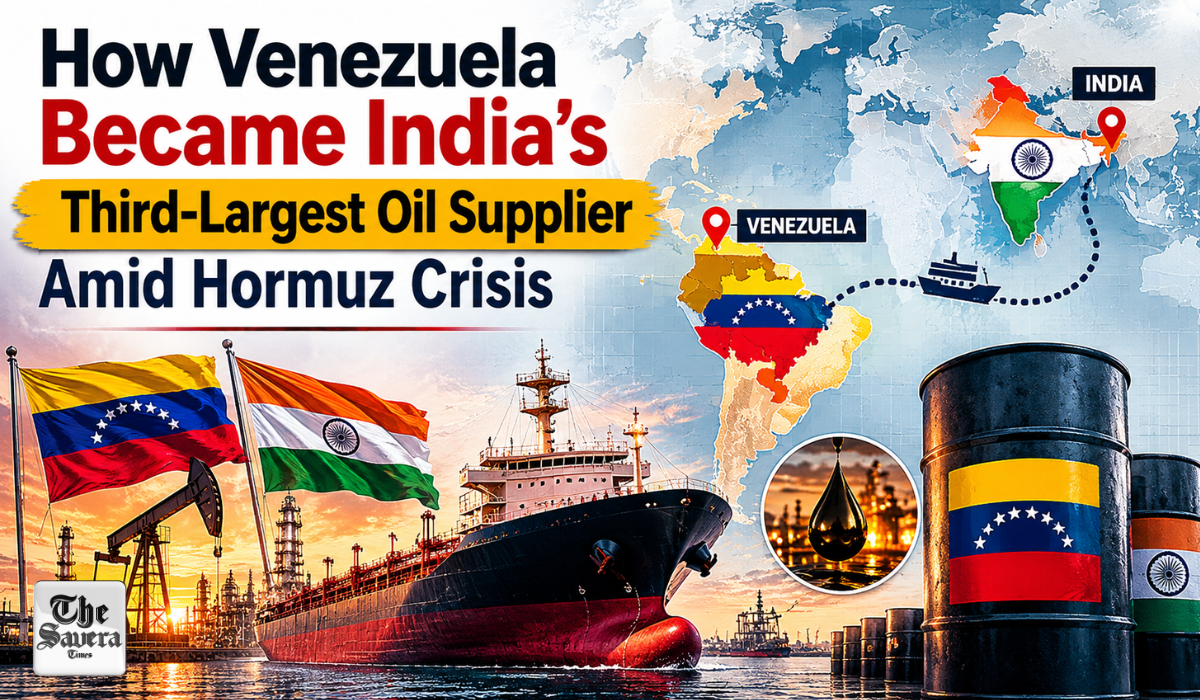
As tensions continue to rise in West Asia and uncertainty surrounding the Strait of Hormuz deepens, India is rapidly changing its crude oil import strategy. In a significant shift, New Delhi is now importing massive amounts of crude oil from Venezuela — a country located nearly 14,000 kilometres away in South America and home to the world’s largest proven oil reserves.
Venezuela has now emerged as India’s third-largest oil supplier in May 2026, overtaking traditional suppliers like Saudi Arabia and even the United States.
So, why is India suddenly turning towards Venezuela? What role do the Strait of Hormuz, Iran, Russia and the United States play in this changing energy equation? And how could this impact India’s foreign policy and global relationships?
What’s Happening?
In May 2026, Venezuela emerged as India’s third-largest supplier of crude oil, behind only Russia and the United Arab Emirates.
According to energy tracking data, India imported nearly 417,000 barrels per day from Venezuela in May, a major jump from around 283,000 barrels per day in April. This is significant because India had imported almost no Venezuelan crude over the last nine months.
The sudden increase is linked directly to the ongoing conflict in West Asia and disruptions around the Strait of Hormuz, one of the world’s most important oil shipping routes.
The Strait of Hormuz connects the Persian Gulf to the Arabian Sea, and nearly one-fifth of the world’s oil trade passes through it.
For India, this route is extremely critical because around 40 per cent of its crude oil imports normally travel through Hormuz.
However, since tensions escalated in West Asia earlier this year, shipping through the region has become risky, expensive and uncertain. This has forced India to look beyond traditional Gulf suppliers and diversify its oil import sources.
Why Venezuela?
There are three major reasons behind India’s growing imports from Venezuela.
1. CHEAPER OIL
Venezuelan crude is currently cheaper than many Middle Eastern and even some Russian oil supplies. Saudi Arabia reportedly raised prices recently, making Venezuelan crude more attractive for Indian refiners.
2. INDIAN REFINERIES CAN PROCESS IT
Venezuela exports heavy crude oil, which not every refinery can handle. However, Indian refiners like Reliance Industries, Nayara Energy, IOCL and HMEL have the technology to process this type of crude efficiently.
3. PARTIAL RELAXATION OF US SANCTIONS
For years, Venezuela’s oil exports suffered due to strict US sanctions under Nicolas Maduro’s government. India also reduced purchases because of payment and diplomatic concerns.
But earlier this year, the United States partially eased restrictions following political developments in Venezuela. This opened the door for India and other countries to resume imports.
India-Venezuela Relations
India and Venezuela have shared oil ties for years.
In the mid-2010s, Venezuela accounted for nearly 12 per cent of India’s crude imports. In 2019, it was India’s fifth-largest oil supplier.
However, trade declined sharply after US sanctions and logistical difficulties.
Now, because of rising geopolitical tensions and energy security concerns, both countries are rebuilding ties again. Venezuela’s interim president Delsey Rodriguez is also expected to visit India soon, signalling stronger energy cooperation.
What About India-Iran Ties?
India’s energy strategy is closely connected to Iran as well.
Before US sanctions on Tehran in 2019, Iran was one of India’s biggest oil suppliers. India also invested heavily in Iran’s Chabahar Port, which is strategically important for trade access to Afghanistan and Central Asia.
However, after sanctions returned, India stopped importing Iranian oil to avoid tensions with Washington.
Now, instability around Iran and the Strait of Hormuz has pushed India to avoid dependence on any single region. That explains why India is now sourcing oil from Russia, Venezuela, the UAE, the US and African countries.
How Does this Impact India’s Global Ties?
With the United States
This remains a delicate balancing act. The US wants India to purchase more American oil and energy products. At the same time, Washington’s partial easing of Venezuelan sanctions has indirectly supported India’s imports.
However, future political changes in Venezuela could once again impact sanctions and create uncertainty.
With Russia
Russia continues to remain India’s largest oil supplier. Reports suggest Russian exports to India touched nearly 2 million barrels per day in May.
Experts believe Russian crude will remain central to India’s energy strategy because it offers stable logistics and competitive pricing. Venezuela is likely to complement Russian oil rather than replace it.
With Gulf Countries
India’s rising imports from Venezuela could slightly reduce dependence on traditional suppliers like Saudi Arabia.
However, India is unlikely to damage ties with Gulf nations because the region remains crucial for trade, energy and millions of Indian workers.
What Does this Means for India?
India imports nearly 90 per cent of its crude oil requirements. That means any war, sanctions or shipping disruption can directly impact fuel prices and inflation.
By increasing imports from Venezuela, India is trying to secure alternative energy routes and reduce dependence on unstable regions.
Still, Venezuela cannot fully replace Middle Eastern suppliers because only a few Indian refineries can process its crude at scale.
The rise of Venezuela as India’s third-largest oil supplier is therefore not just an oil story. It reflects how global conflict, sanctions and geopolitics are reshaping India’s energy strategy in an increasingly uncertain world.
Ladakh is seeing two changes at once: a new district has been announced, and the Centre has proposed...

What if a decision taken in Washington could influence India’s oil bills, export earnings and trade relations with...
What happens when the world’s richest business leaders clash over one of the world’s biggest internet markets? A...

Pakistan is heading into its wheat-growing season with a serious water problem. The country is facing a projected...
Imagine a foreign national standing among Indian citizens at a political protest, raising questions about the government or...

For thousands of Indian tech workers in the United States, a job offer is only the beginning of...

Aries: The day will be auspicious...