Last Updated: October 16, 2026
Last Updated: October 16, 2026





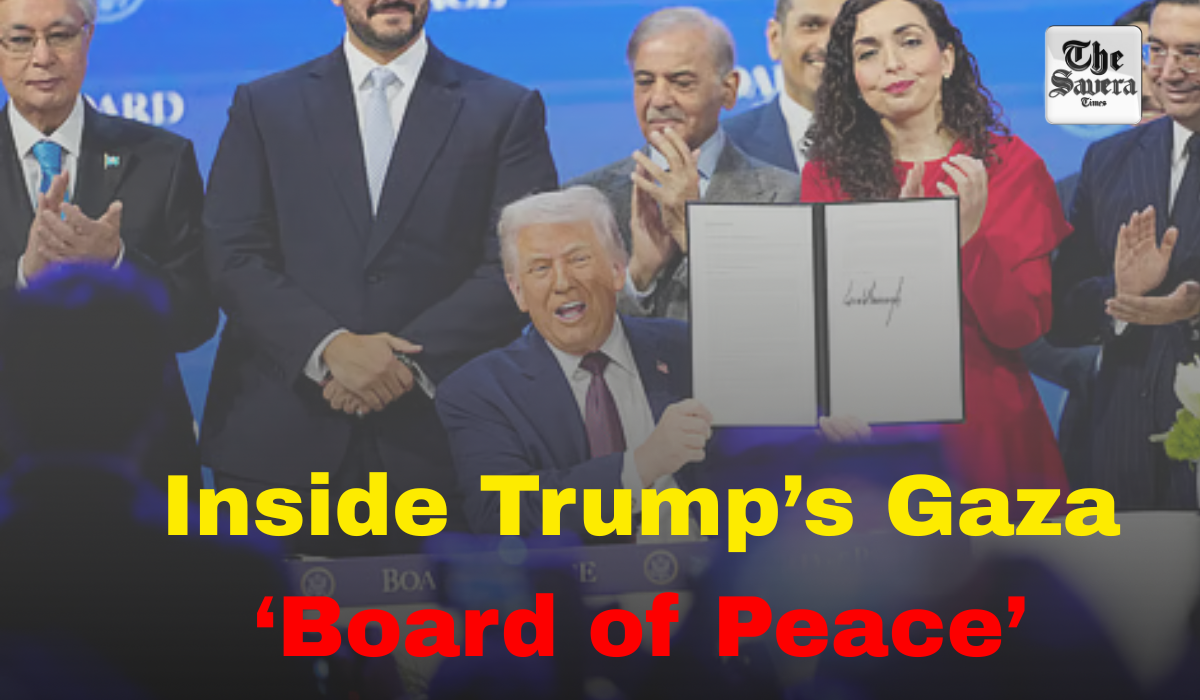
President Donald Trump’s newly launched Gaza ‘Board of Peace’ has moved from concept to controversy in just days. Israel’s decision to join—despite an active ICC (International Criminal Court) arrest warrant against Prime Minister Benjamin Netanyahu—has given the initiative fresh momentum and global attention. But the mix of countries signing on, staying out, or sitting on the fence raises a larger question: how powerful is this board, really?
What Is Trump’s Board of Peace?
The Board of Peace is a new, US-led international body designed to oversee Gaza’s post-war recovery after nearly two years of devastating conflict. Its stated goals include rebuilding infrastructure, restoring basic services, attracting investment, and guiding Gaza’s transition away from Hamas rule toward what the White House calls “stable, technocratic governance.”
Trump has described the board as a “transformative international organisation,” suggesting it could eventually expand beyond Gaza to address other global conflicts—positioning it, in effect, as an alternative to traditional multilateral forums like the UN Security Council.
At its core, the board aims to centralise political authority, funding decisions, and reconstruction planning under a tightly managed international framework.
When and Why Was It Launched?
The board was unveiled on January 13, 2026, as the flagship element of Phase Two of Trump’s 20-point peace plan for Gaza. That plan followed a fragile ceasefire reached in October 2025, after months of intense fighting that left much of Gaza destroyed and its population dependent on aid.
Trump has framed the initiative as a response to what he calls the failure of existing international institutions, particularly the United Nations, to resolve long-running conflicts. The goal, according to US officials, is rapid stabilisation—preventing Hamas from re-emerging, restoring order, and drawing in a wide coalition of states to share responsibility for Gaza’s future.
How Is the Board Structured?
Trump chairs the Board of Peace himself, keeping firm control at the top. The core leadership includes:
Former UN diplomat Nickolay Mladenov serves as High Representative, tasked with overseeing Gaza’s transition from Hamas rule to a new technocratic body—the National Committee for the Administration of Gaza (NCAG). The NCAG is led by Palestinian official Ali Shaath and is responsible for day-to-day governance and public services.
A separate Gaza Executive Board supports operational delivery, with participation from officials linked to Turkey, Qatar, Egypt, and the United Nations.
What Are the Latest Developments?
The biggest shift came on January 21, 2026, when Israel formally confirmed its decision to join. Prime Minister Netanyahu’s office said the board could help end the Gaza conflict and potentially address other international disputes.
This followed confirmations from Bahrain on January 20 and the United Arab Emirates, which quickly endorsed Trump’s plan. Azerbaijan and Armenia—long-time rivals—also signed on, highlighting the board’s unusual mix of partners.
A formal signing ceremony is expected on the sidelines of the World Economic Forum in Davos, though controversy remains over reports that permanent membership could require a $1 billion financial contribution.
Who’s In?
Countries that have confirmed participation include:
Canada has said it will take part in the process but will not pay for permanent membership.
Who’s Out?
Several countries have declined outright:
Who’s Still Undecided?
A number of key players are still weighing their options:
What Remains Unclear?
Despite invitations sent to more than 60 world leaders, major questions remain unanswered:
Who ultimately makes decisions? How binding are they? Where does the money come from? And will this body remain focused on Gaza—or attempt to reshape global conflict resolution altogether?
As Davos approaches, Trump’s Board of Peace stands at the centre of a high-stakes geopolitical experiment—part reconstruction plan, part power play, and potentially a challenge to the existing international order.
Manjit Singh Bedi, 64, has been returned to the United States after being arrested in India. He faces...
A Houthi attack on the al-Maashiq Presidential Palace in Aden killed five people and injured 16, amid intensifying...
A shooting at Silver Rail Elementary School in Bend, Oregon, left three children and a teacher dead. The...

Prime Minister Narendra Modi will visit Canada on December 11-12, 2026, with both countries aiming to strengthen strategic...
US Vice President JD Vance has warned that anyone found selling access to the White House should face...
Washington: US President Donald Trump has claimed that drug cartels effectively control Mexico and warned that his administration...

Aries: The day will be auspicious...