Last Updated: October 21, 2026
Last Updated: October 21, 2026





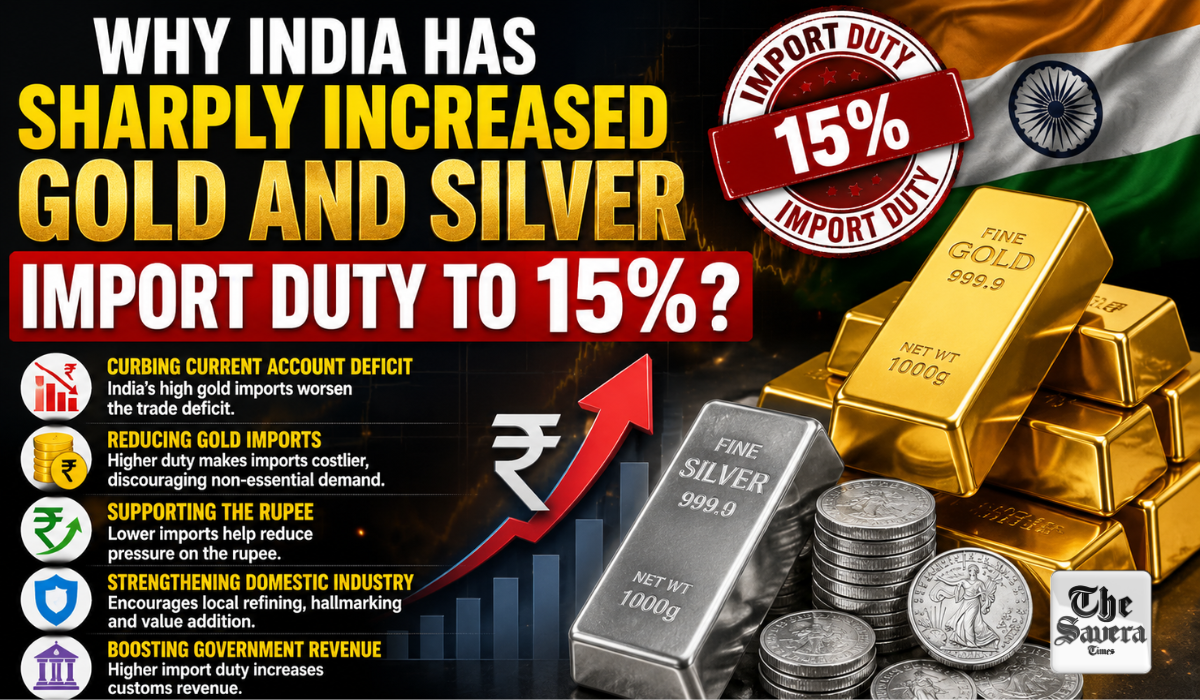
Gold has always been more than just a metal in India. It is emotion, tradition, investment, and financial security for millions of families. But now, buying gold and silver in India is set to become much more expensive.
In a major policy move, the government has sharply increased the effective import duty on gold and silver from 6 per cent to 15 per cent — one of the biggest hikes in recent years.
The decision comes at a time when India is facing pressure from rising crude oil prices, a weakening rupee, and growing concerns over foreign exchange reserves amid global tensions involving the United States and Iran.
What Exactly Has Changed?
Under the new structure notified by the Ministry of Finance through Customs Notification No. 16/2026, the Basic Customs Duty on gold and silver has been increased from 5 per cent to 10 per cent.
At the same time, the Agriculture Infrastructure and Development Cess, or AIDC, has been raised from 1 per cent to 5 per cent.
This takes the total effective import duty from 6 per cent to 15 per cent.
The move came into effect on May 13, 2026.
The government has also revised duties on jewellery-related inputs and introduced concessional rates for recycled precious metals and recovery materials. This indicates that the government wants the industry to depend more on recycling instead of importing fresh gold.
Why Has the Government Taken This Step?
The biggest reason is India’s rising import bill.
India is one of the world’s largest consumers of gold, but almost all of it is imported. This means India has to spend huge amounts of dollars every year to buy gold from other countries.
Reports suggest India spent nearly 72 billion dollars on gold imports in 2025-26 alone.
At the same time, crude oil prices are rising due to tensions in West Asia. Since India imports most of its crude oil too, the pressure on foreign exchange reserves has increased sharply.
Prime Minister Narendra Modi recently urged citizens to avoid unnecessary imports, reduce fuel consumption, postpone foreign travel, and even delay gold purchases for a year in order to conserve foreign exchange reserves.
The government believes that making gold and silver more expensive could reduce imports and help control the outflow of dollars.
Pressure on the Rupee
Another major concern is the weakening Indian rupee.
The rupee recently touched a record low of 95.68 against the US dollar. When India imports more goods like oil and gold, demand for dollars rises in the market. This puts further pressure on the rupee.
By reducing non-essential imports like gold, the government hopes to ease pressure on the currency and improve the country’s external financial position.
Economists say gold imports do not directly contribute to manufacturing or exports, unlike machinery or industrial equipment. Therefore, reducing gold imports is seen as a way to improve India’s trade balance.
Impact on Gold Prices and Consumers
The immediate impact of the duty hike is already visible in the market.
Domestic gold futures jumped more than 7 per cent after the announcement, while silver prices also surged sharply.
Higher import duty means jewellers now have to pay much more to bring gold into India. This cost will ultimately be passed on to customers.
For example, under the earlier 6 per cent duty structure, the duty on gold worth Rs 1,54,750 was around Rs 9,285. Under the new 15 per cent structure, the duty rises to more than Rs 23,000.
This means jewellery purchases for weddings, festivals, and investments are likely to become much more expensive.
Experts believe many consumers may now delay purchases, exchange old jewellery for new designs, or shift toward gold ETFs and digital gold instead of physical gold.
Concerns for the Jewellery Industry
While the government sees the move as necessary for economic stability, the jewellery and bullion industry is worried.
Higher duties increase business costs for jewellers and bullion traders. Industry officials fear weaker demand could hurt millions of workers connected to the jewellery sector, including artisans and craftsmen.
Another major concern is gold smuggling.
India has historically seen a rise in illegal gold imports whenever duties become very high. Industry experts warn that the jump to 15 per cent may once again make smuggling profitable through illegal routes and grey markets.
For now, the government’s message is clear — reducing gold imports has become part of India’s larger strategy to protect foreign exchange reserves, support the rupee, and manage economic pressure during a period of global uncertainty.
Ladakh is seeing two changes at once: a new district has been announced, and the Centre has proposed...

What if a decision taken in Washington could influence India’s oil bills, export earnings and trade relations with...

What happens when the world’s richest business leaders clash over one of the world’s biggest internet markets? A...

Pakistan is heading into its wheat-growing season with a serious water problem. The country is facing a projected...

Imagine a foreign national standing among Indian citizens at a political protest, raising questions about the government or...

For thousands of Indian tech workers in the United States, a job offer is only the beginning of...

Aries: The day will be auspicious...