Last Updated: September 22, 2026
Last Updated: September 22, 2026





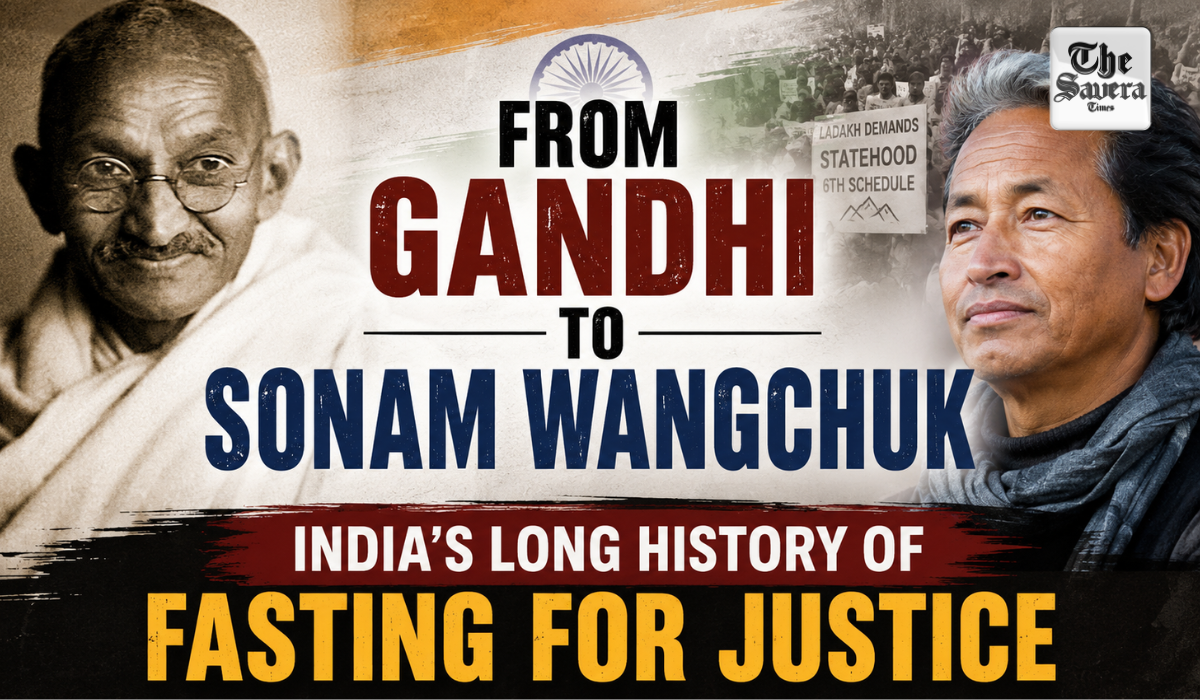
Twenty days without food. Over nine kilograms lost. A determined activist lying at Jantar Mantar, fighting for education reforms and the resignation of Union Education Minister Dharmendra Pradhan. Sonam Wangchuk’s hunger strike has captured national attention, raising urgent questions: Is this protest legal? When does the state step in? And why do some fasts succeed while others end in stalemate?
Sonam Wangchuk’s Current Protest
Engineer, education reformer, and climate activist Sonam Wangchuk from Ladakh began his indefinite hunger strike on June 28, 2026. He is demanding accountability over NEET paper leaks and broader education system reforms. Doctors report he has lost more than nine kilograms, with his body now breaking down muscle tissue.
The Delhi High Court, responding to a PIL, ordered daily medical monitoring and timely treatment but stopped short of force-feeding. It emphasised that every citizen’s life is precious under Article 21 of the Constitution.
Hunger strikes are legal in India. Peaceful fasting is protected under Article 19(1)(a) and 19(1)(b) — freedom of speech, expression, and peaceful assembly.
However, the state has a duty to protect life. Police cannot arrest someone just for fasting, but they can act if public order is disturbed. In Wangchuk’s case, the focus remains on medical supervision rather than coercion.
A Powerful Tool with Mixed Results
Hunger strikes have shaped India’s history, often forcing governments to act — but success is never guaranteed.
Mahatma Gandhi
Used fasting as a moral weapon for communal harmony, workers’ rights, and political unity. His fasts helped stop violence in Calcutta in 1947 and influenced labour disputes. They succeeded by shifting public opinion rather than direct pressure.
Potti Sreeramulu
Fasted for 56 days in 1952 demanding a separate Andhra State for Telugu speakers. His death sparked riots, forcing Prime Minister Nehru to create the state. This led to the linguistic reorganisation of India — a tragic but clear victory.
K. Chandrashekar Rao (KCR)
Undertook an 11-day fast in 2009 for Telangana statehood. It triggered massive protests and forced the central government to announce the state’s creation — a major political success.
Sonam Wangyal
Wangchuk’s father fasted in 1984 for Scheduled Tribe status for Ladakh. Prime Minister Indira Gandhi intervened personally, paving the way for ST status in 1989.
Modern Examples: Breakthroughs and Limits
Anna Hazare
His 2011 anti-corruption fast at Ramlila Maidan was highly successful initially. His demand for a strong Jan Lokpal Bill sparked nationwide protests. The UPA government conceded in Parliament, leading to the Lokpal Act 2013. It also boosted the Aam Aadmi Party and contributed to the UPA’s defeat in 2014.
Irom Sharmila
Her 16-year fast (2000–2016) against AFSPA in Manipur ended without repeal. Authorities force-fed her through a nasal tube. She later entered politics but saw limited electoral success.
G.D. Agarwal (Swami Sanand)
Fasted for 111 days in 2018 to protect the Ganga. His demands were ignored, and he died without concrete policy changes.
Sonam Wangchuk’s Track Record (2023–2026)
Wangchuk has led multiple fasts. His 21-day climate fast in 2024 and later protests demanded Ladakh’s statehood and Sixth Schedule protections. These mobilised locals, drew global attention, and prompted brief central government talks. Yet core demands remain unmet. He faced detention under NSA in late 2025 (later revoked).
His 2026 education strike continues amid government resistance, reflecting the pattern of awareness without immediate legislative wins.
Historically, hunger strikes deliver quick political attention and sometimes concessions. Long-term implementation often stalls, especially against a strong central government.
The Constitutional Balance
India’s democracy allows citizens to protest through fasting. At the same time, the state must prevent loss of life. Courts usually order monitoring and treatment rather than force-feeding unless a life is in immediate danger.
Wangchuk’s case tests this balance: the right to protest versus the duty to protect life.
As support grows from leaders like Arvind Kejriwal, Mahua Moitra, and celebrities including Shabana Azmi and Naseeruddin Shah, the nation watches. Will this strike bring education reforms or join the list of powerful but partially successful protests? India’s hunger strike tradition continues — a reminder of both democratic strength and its limits.
A conflict already threatening the Strait of Hormuz is now putting another crucial waterway in the spotlight —...

Petrol pump dealers across India are threatening a sweeping “cash-only” strike for high-value fuel purchases, alongside multi-party-political protests,...

A rate decision in Washington may sound far removed from an Indian household, but it can travel quickly...
For years, the biggest test in India-China ties was the border. Now, as both countries try to bring...
Copper has crossed a level never seen before, while Brent crude has moved back above $100 a barrel....

For years, the Samajwadi Party’s electoral identity in Uttar Pradesh was closely linked to the Muslim-Yadav, or MY,...

Aries: The day will be auspicious...